Truck Classes Explained: GVWR, Class 1-8 Chart and Class 6, 7 and 8 Trucks

Last updated November 2026.
Truck Classes: Key Facts
Truck classes sort every commercial truck into eight groups by weight, from a light pickup up to a loaded semi. The group is set by a truck’s Gross Vehicle Weight Rating (GVWR), the maximum loaded weight the manufacturer rates it to carry. Here is the short version before the full chart:
- How classes work: Classes 1 through 8 rank trucks by GVWR, so a higher number means a heavier truck.
- The dividing line: a GVWR of 26,001 pounds separates lighter trucks from the Class 7 and Class 8 trucks that usually need a commercial driver.
- Classes 6, 7, and 8: the medium- and heavy-duty working trucks, from single-axle vocational trucks up to semi-tractors.
- Where CSM fits: CSM Companies sells, leases, and services new and used Kenworth trucks across the medium- and heavy-duty classes.
What Does GVWR Mean?
GVWR stands for Gross Vehicle Weight Rating. It is the maximum total weight a truck is built to carry, including the empty truck, fuel, driver, passengers, and cargo. GVWR sets a truck’s class, so every class question starts there. The manufacturer prints it on the door-jamb certification sticker and the VIN plate.
GVWR vs. Curb Weight vs. Payload
Three weight terms get mixed up, and the difference matters when you size a truck. Each describes a different part of the load:
- Curb weight: the empty truck with fluids, but no cargo, passengers, or driver.
- Payload: what the truck can carry, which is the GVWR minus the curb weight.
- GVWR: the rated ceiling for the loaded truck, which you should never exceed.
A fourth rating, the Gross Axle Weight Rating (GAWR), caps the weight on each axle, so a legal load stays within both ratings.
GVWR vs. GCWR (Why Class 8 Tractors Pull 80,000 lbs)
GVWR covers a single truck. The Gross Combination Weight Rating (GCWR) covers a truck and everything it tows, so it is the number that matters for a tractor-trailer. A Class 8 tractor’s GCWR is far higher than its GVWR, which is how a loaded combination reaches the federal limit of 80,000 pounds set in 23 CFR 658.17, along with a 20,000-pound single-axle and 34,000-pound tandem-axle cap.
Truck Classes 1-8: GVWR Classes Chart
The chart below follows the weight classes used by the Federal Highway Administration and the U.S. Department of Energy (DOE). Each class is a GVWR band with no gaps or overlaps, so every truck lands in exactly one class.
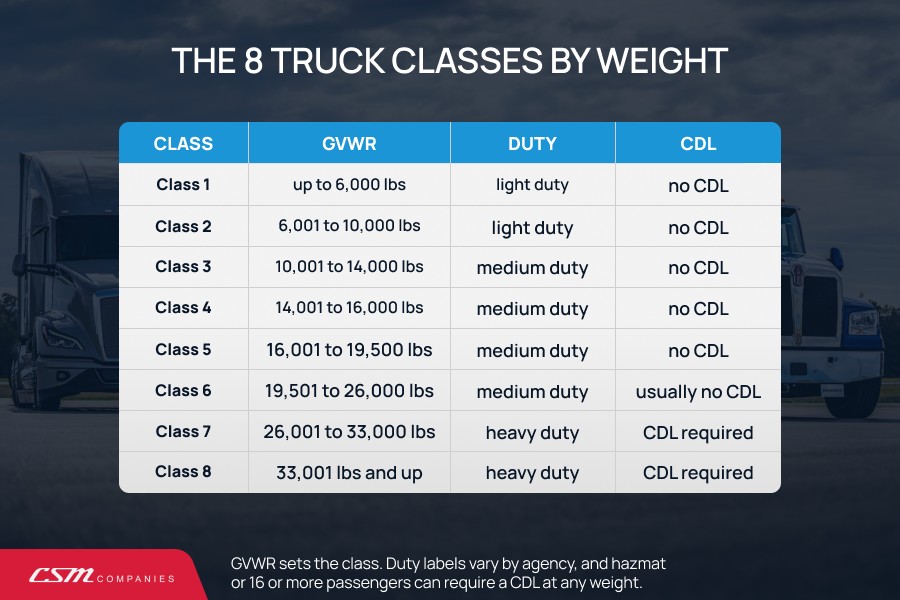
The “CDL by weight” column reflects weight only. Hauling placarded hazardous materials or carrying 16 or more passengers can require a CDL at any weight.
The GVWR bands are consistent, but duty labels vary by agency, so use the class number and its range as the reliable guide, not the word next to it.
Medium Duty (Classes 3-6)
Medium-duty trucks span 10,001 to 26,000 pounds GVWR, covering Classes 3 through 6. These are the box trucks, delivery trucks, and single-axle work trucks that move goods around a city or region, most without a CDL.
Heavy Duty (Classes 7-8)
Heavy-duty trucks start at 26,001 pounds GVWR and cover Classes 7 and 8. These are the vocational trucks, dump trucks, and semi tractors that do the heaviest work and require a commercial driver. For the broader definition, see our guide on what a heavy-duty truck is.
What Is a Class 6 Truck?
A Class 6 truck is a medium-duty truck with a GVWR of 19,501 to 26,000 pounds. Its ceiling sits one pound below the 26,001-pound CDL threshold, which makes it the heaviest class most drivers can operate without a commercial license. That keeps staffing simple while the truck still handles route, utility, and single-axle vocational work.
Class 6 Examples: Kenworth T280 and Mack MD6
Two current medium-duty models land squarely in Class 6:
- Kenworth T280: rated up to 26,000 pounds GVWR, a true Class 6 truck. Its lighter sibling, the T180, is a Class 5 truck at up to about 19,000 pounds.
- Mack MD6: rated at 25,995 pounds GVWR, placing it in Class 6.
What Is a Class 7 Truck?
A Class 7 truck is a heavy-duty truck with a GVWR of 26,001 to 33,000 pounds. Crossing 26,001 pounds moves a single truck into CDL territory, so Class 7 is the first class that generally requires a commercial driver. These trucks take on refuse, dump, utility, and heavier straight-truck work.
Class 7 Examples: Kenworth T380 and Mack MD7
Two models anchor the Class 7 range:
- Kenworth T380: rated up to 33,000 pounds GVWR. The T480 shares its cab but is rated higher, into Class 8.
- Mack MD7: rated at 33,000 pounds GVWR, at the top of Class 7.
What Is a Class 8 Truck?
A Class 8 truck is a heavy-duty truck with a GVWR above 33,000 pounds. It is the top class, with no upper limit, covering both the semi tractors that pull freight and the heaviest vocational trucks. Every Class 8 truck requires a CDL.
Class 8 Semi-Trucks vs. Class 8 Vocational Trucks
Class 8 splits into two broad jobs, and the right truck depends on which one you do:
- Semi tractors: on-highway trucks built to pull trailers over the road, for miles, fuel economy, and driver comfort.
- Vocational trucks: dump trucks, mixers, and heavy work trucks built for payload and durability.
Class 8 Examples: Kenworth and Mack
Class 8 is where the best-known heavy trucks live:
- Kenworth: the T680 on-highway tractor, the T880 vocational truck, and the W990 and W900 long-hood tractors.
- Mack: the Anthem and Pinnacle highway tractors, and the Granite vocational and dump truck.

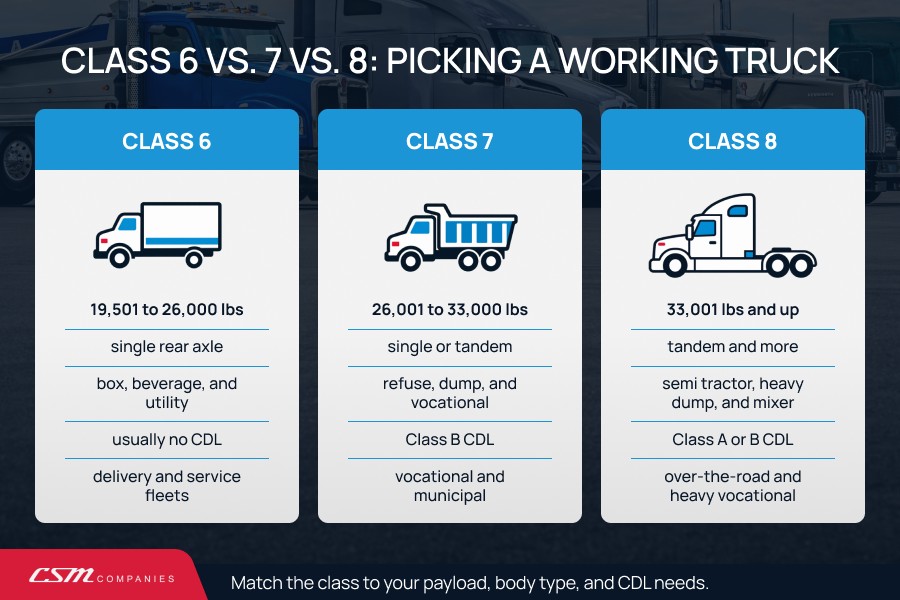
Class 6 vs. Class 7 vs. Class 8: Which Truck Class Fits Your Work?
The three working classes overlap in some jobs, so the choice comes down to payload, body type, and whether you want a CDL requirement. Start from the heaviest load you will carry, keep a margin below the GVWR ceiling, and let the table guide the rest.
Truck Class and CDL Requirements
Truck class and CDL rules are tied together by weight. The Federal Motor Carrier Safety Administration (FMCSA) sets the commercial license groups in 49 CFR 383.91, and the 26,001-pound line decides whether a driver needs a CDL at all.
The 26,001-lb Threshold
A GVWR of 26,001 pounds is the federal trigger for a commercial driver’s license. At or below 26,000 pounds, a single truck generally needs none, and at 26,001 pounds and above the driver needs one. That is why the line between Class 6 and Class 7 matters so much for staffing, since a hazardous-materials placard or 16 or more passengers can still require a CDL below that weight.
CDL Class A vs. B vs. C by Truck Class
The license groups match the kind of truck and how it is combined. Under the federal definitions, they break down like this:
- Class A: a combination rated 26,001 pounds or more, towing a unit over 10,000 pounds. This is the over-the-road tractor-trailer license.
- Class B: a single vehicle of 26,001 pounds or more, which covers most Class 7 and straight-truck Class 8 work.
- Class C: smaller vehicles used to carry hazardous materials or 16 or more passengers.
Endorsements to Know (Hazmat, Tanker, Air Brakes)
A CDL can carry extra endorsements and restrictions beyond the base class. The common ones to plan for are:
- Hazmat (H): required to haul placarded hazardous materials, with a background check.
- Tanker (N): required to haul liquid or gas in bulk.
- Air brake restriction: testing in a vehicle without air brakes bars you from air brake trucks, so test in the right equipment.
Whatever class a driver runs, a consistent pre-trip routine keeps the truck road-ready. Our CDL pre-trip inspection checklist walks through every zone.
Finding the Right Class 6, 7 or 8 Truck at CSM Companies
Once you know the class you need, the next step is matching a real truck to your routes, payload, and budget. CSM Companies supports that choice from the first spec to long-term service.
Buy New or Used
CSM carries new and used Kenworth trucks across the medium- and heavy-duty classes. New trucks let you spec the exact GVWR, axle, and body; used trucks lower the upfront cost for a given class.
Lease or Rent
Not every job calls for ownership. Premier Leasing & Rental offers full-service leases and short-term rentals for testing a route, covering a seasonal peak, or keeping capital free, and a lease can bundle maintenance for predictable cost.
Service and Parts Across 24 Locations
A truck is only as valuable as its uptime. CSM backs every class with service centers and truck parts across 24 dealership locations in five states, plus dedicated fleet services that build a maintenance routine around your trucks.
Truck Classes FAQs
Quick answers to the questions buyers and drivers ask most:
What are the different classes of trucks?
Trucks are sorted into Classes 1 through 8 by GVWR: Classes 1 and 2 are light duty, 3 through 6 are medium duty, and 7 and 8 are heavy duty.
What are Class 6, 7 and 8 trucks?
Class 6 trucks are rated 19,501 to 26,000 pounds, Class 7 trucks 26,001 to 33,000 pounds, and Class 8 trucks above 33,000 pounds. They are the medium- and heavy-duty working trucks, up to semi tractors.
What is a Class 2 or 3 truck?
A Class 2 truck is rated 6,001 to 10,000 pounds, and a Class 3 truck 10,001 to 14,000 pounds. Class 2 covers heavy-duty pickups and vans, Class 3 covers larger pickups and utility trucks, and neither needs a CDL by weight.
Is a semi-truck always Class 8?
In practice, yes. A semi tractor built to pull a loaded trailer has a GVWR above 33,000 pounds, which places it in Class 8.
Do I need a CDL to drive a Class 6 truck?
Usually not, since a Class 6 truck is rated at or below 26,000 pounds, under the CDL threshold. You would still need one to haul placarded hazardous materials or carry 16 or more passengers.
Which is easier, CDL A or B?
A Class B CDL is generally simpler to earn, since it covers a single heavy vehicle rather than a combination. A Class A CDL requires a tractor-trailer, but it qualifies you for the widest range of trucks.