Leasing vs Buying a Semi-Truck: Costs, Pros and Cons
Leasing vs Buying a Semi-Truck: Key Facts
Truck leasing and buying are two routes to the same thing: a truck that earns. Which one fits comes down to cash, maintenance, and how you run. The quick version:
- What truck leasing is: you pay to use a truck for a set term instead of owning it, often with maintenance bundled in.
- What buying is: you finance or purchase the truck outright and own the asset, along with its upkeep, depreciation, and resale.
- The real comparison: weigh total cost of ownership, not just a monthly lease payment against a loan payment.
- Four options, not two: full-service lease, purchase, rental, and lease-to-own each fit a different situation.
- Where CSM fits: Premier Leasing & Rental offers full-service Kenworth leases, rentals, and custom maintenance programs through the PacLease network.
Truck Leasing vs Buying a Semi-Truck: What’s the Difference?
The difference between truck leasing and buying comes down to ownership. With a lease you pay for the use of a truck over a set term and hand it back or buy it at the end. As a result, this keeps upfront costs lower and expenses more predictable. With a purchase you own the asset outright, which gives you control and any resale value, along with full responsibility for maintenance, depreciation and replacement.
Neither leasing nor buying is universally better. The right call depends on your fleet size, annual mileage, cash flow, in-house maintenance capability, how often you replace trucks, and how hard each truck is utilized.
What Does Truck Leasing Mean?
Truck leasing is a financing and service arrangement where you use a truck for a fixed term and monthly payment rather than owning it. A full-service lease can also bundle in maintenance and support, so the payment covers more than just the vehicle.
What Does Buying a Semi-Truck Involve?
Buying a semi-truck means purchasing it outright or financing it with a loan, then owning the asset. You carry the depreciation, the maintenance and the resale or replacement when the truck ages out.
Which Option Is Better for Fleet Operators?
There is no single answer to which option is better for fleet operators. Operators who value predictable costs and uptime often lean toward leasing, while those with capital and a strong shop often buy. The rest of this guide breaks down the numbers and the trade-offs to help you match the choice to your operation.
Full-Service Lease vs Purchase vs Rental vs Lease-to-Own
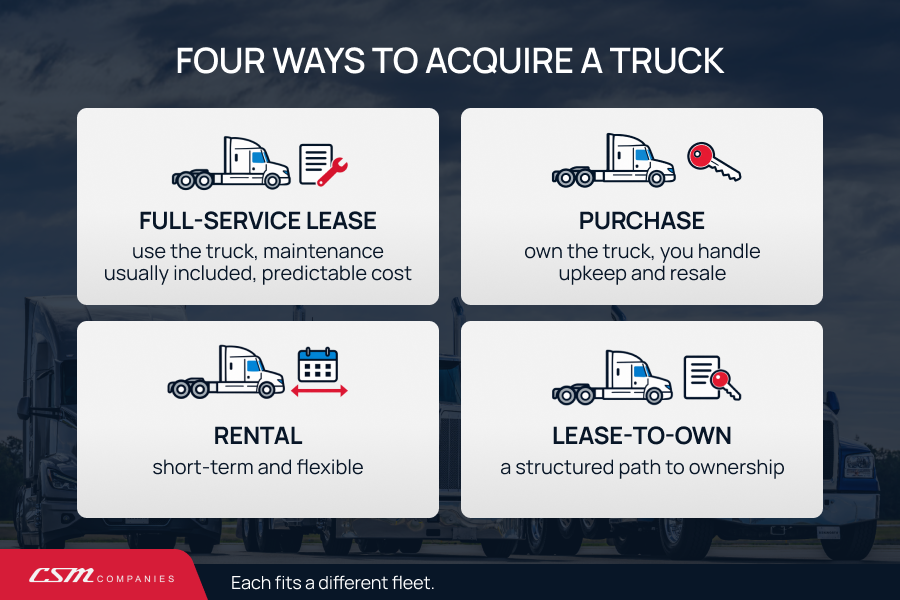
Leasing vs buying is not really a two-option decision. There are four common ways to put commercial truck capacity on the road, and each handles cost, maintenance and ownership differently. Here is how they compare:
| Factor | Full-Service Lease | Purchase | Rental | Lease-to-Own |
|---|---|---|---|---|
| Upfront Cost | Low to moderate | High | Low | Low to moderate |
| Monthly Cost Predictability | High | Moderate | High | Moderate |
| Maintenance | Typically included | Owner responsibility | Typically provider-managed | Varies by agreement |
| Ownership / Equity | No | Yes | No | Potential ownership |
| Flexibility | Moderate | Low to moderate | Very high | Moderate |
| Best For | Fleets prioritizing uptime and predictable costs | Fleets keeping trucks long term | Seasonal, temporary or emergency capacity | Operators seeking a path toward ownership |
Exact inclusions vary by contract and provider, so treat the table as a starting point rather than a universal rule. Commercial truck leasing, semi-truck rental and semi-truck lease to own all sit on this same spectrum between pure usage and full ownership.
Cost Comparison: Leasing vs Buying a Semi-Truck
Any costs and figures referenced here are broad industry estimates. Actual pricing varies by truck specification, build date, market conditions, location, lease structure, and available incentives.
The real cost comparison is not the monthly lease payment against a loan payment. It is the total cost of ownership (TCO), the full set of costs each option carries over the life of the truck. A lease can look more expensive per month and still cost less overall once maintenance, downtime, and resale risk are counted, or the reverse, depending on how you run.
Upfront Costs
Buying a semi-truck usually means a large down payment or a full cash purchase, which ties up capital. Truck leasing typically requires far less cash up front, which preserves working capital for fuel, drivers, and growth.
Monthly Payments and Cash Flow
A lease turns much of the cost of a truck into a predictable recurring payment, which makes budgeting and cash flow easier to manage. A purchase can cost less month to month once a loan is paid off, but it front-loads the expense and the risk.
Maintenance and Repair Costs
When you buy, maintenance and repair risk sit with you. A full maintenance lease for a semi-truck can fold scheduled service and covered repairs into the program, which turns an unpredictable cost into a planned one. How much that is worth depends on how much in-house service capacity you already have.
Depreciation and Resale Value
An owner keeps the truck’s residual value but also absorbs depreciation and the risk of a soft resale market. A lease shifts most of that residual risk to the lessor, which matters when used-truck values swing. The tax treatment differs too: IRS Publication 946 covers how owned equipment is depreciated, and IRS Publication 463 explains how a leased business vehicle is handled.
Downtime and Replacement Vehicle Costs
The cost owners most often miss is downtime. A truck in the shop is not earning, and a breakdown can mean a missed load plus the cost of a rental to cover it. Full-service leases and rental options exist partly to limit that exposure.
Here is a simple view of which costs typically sit with the fleet versus the provider under each model:
| Cost or risk | Purchase | Full-Service Lease | Rental | Lease-to-Own |
|---|---|---|---|---|
| Upfront capital | Fleet (high) | Fleet (low) | Fleet (low) | Fleet (low to moderate) |
| Maintenance and repairs | Fleet | Provider, per contract | Provider | Varies by agreement |
| Depreciation and resale risk | Fleet | Provider | Provider | Shifts toward fleet |
| Downtime and replacement | Fleet | Often provider-supported | Provider | Varies |
| Ownership at end of term | Fleet | None | None | Fleet, on completion |

Pros and Cons of Truck Leasing
Truck leasing has clear advantages, but it is not automatically the better choice. Here is a balanced view, starting with the upside:
- Lower initial capital requirements
- More predictable fleet expenses
- Access to newer equipment
- Simpler, more regular replacement cycles
- Reduced exposure to resale-value risk
- Maintenance support under full-service programs
- Internal resources freed up for core operations
These benefits come with certain trade-offs. Lease agreements may place restrictions on mileage, vehicle modifications, and early termination, depending on the contract. Fleets should weigh these conditions against the financial predictability and maintenance support leasing provides.
- No vehicle equity under a conventional lease
- Contract terms and mileage limits to work within
- Possible charges depending on the contract
- Less freedom to dispose of or modify the truck
- Long-term economics that vary by utilization and lease structure
Premier Leasing & Rental offers full-service leasing programs that can include scheduled maintenance and roadside support. The specific services and coverage depend on the terms of the lease agreement.
Pros and Cons of Buying a Semi-Truck
Buying a semi-truck makes sense for operations that have the capital and resources to manage their own equipment. Ownership gives fleets greater control over vehicle specifications, maintenance schedules, and replacement decisions. It also provides the opportunity to recover some of the investment through resale. The main advantages include:
- The business owns an asset
- Potential resale value at the end of the lifecycle
- No lease-end restrictions or mileage limits
- Full control over vehicle lifecycle and modifications
- Potential long-term cost advantages when trucks are well maintained and kept for years
Ownership also brings financial and operational responsibilities. Beyond the purchase price, fleets must account for maintenance, unexpected repairs, and depreciation.
These expenses can affect the long-term cost of ownership, particularly as trucks age. The main considerations include:
- Significant upfront capital or financing
- Depreciation risk
- Full maintenance and repair responsibility
- Internal staffing, parts and shop requirements
- Unexpected repair expenses
- Resale and replacement responsibilities
Who Should Consider Buying?
Buying tends to favor fleets with strong capital availability, an established maintenance operation, predictable utilization and a plan to keep trucks in service for a long lifecycle. If you can absorb repair risk and want the asset, ownership can pay off over many years. If you would rather finance a purchase, CSM Financial can help structure it.
When Does Full-Service Truck Leasing Make the Most Sense?
Full-service truck leasing is more than a way to finance a truck. Its value comes from pairing up the equipment with fleet-management support, so it fits best when uptime and predictable costs matter more than owning the asset. It tends to make the most sense for:
- Companies that want predictable operating expenses
- Fleets without extensive in-house maintenance capabilities
- Businesses that want to preserve working capital
- Fleets with strict delivery or uptime requirements
- Operations that refresh trucks on a regular cycle
- Businesses whose core competency is not fleet maintenance
What Does a Full Maintenance Lease for a Semi-truck Include?
A full maintenance lease for a semi-truck bundles the vehicle with ongoing service. Coverage commonly includes scheduled preventive maintenance, covered repairs and roadside support, and it can extend to substitute vehicles and telematics. Exact coverage depends on the contract, so read what is in and out before you sign.
Why Maintenance Matters in a Lease-vs-Buy Calculation
Maintenance is often the deciding factor. Shop labor, parts, technician staffing and downtime can swing the real cost of ownership more than the purchase price does. Folding that into a lease makes the number predictable, which is the whole point for fleets that would rather not run a shop.
How Premier Leasing & Rental Supports Full-Service Leasing
CSM provides full-service leasing through Premier Leasing & Rental, backed by the national PacLease network of more than 490 locations. Programs can bundle scheduled maintenance and roadside support, with real-time telematics through PacTrac and tax reporting through PacTax, and the exact mix is built around your routes and budget. You can see the full leasing and rental options on the CSM Companies site.
When Is Semi-Truck Rental a Better Option?
A semi-truck rental is the right tool when the need is short-term or uncertain. Unlike a long-term commercial truck lease, a rental is measured in days, weeks or months, which makes it better suited to temporary capacity than to a permanent fleet decision. Rental tends to fit when you have:
- Seasonal demand
- An unexpected breakdown to cover
- A temporary contract
- A short-term spike in freight
- A new lane or market to test
- A wait for permanent replacement equipment
Rental vs Leasing a Truck
The simple distinction: rental is the flexible short-term option, and leasing is the predictable long-term fleet strategy. If you need a truck for a season or to cover one in the shop, rent. If you need trucks on the road for years, lease or buy. The same logic applies to box truck leasing or rental for medium-duty delivery fleets, not just Class 8 tractors.
What to Consider With a Semi-Truck Lease-to-Own Agreement
A semi-truck lease to own is a lease structured with a path to ownership. You make payments to use the truck, and at the end you have an option or an obligation to buy it, which sets it apart from a conventional commercial fleet lease that you simply return. Before signing one, work through:
- The purchase option or ownership terms
- The total payments over the agreement
- Maintenance responsibilities
- Mileage requirements
- Early termination provisions
- Residual or balloon payments
- Who carries repair and downtime risk
Lease-to-own is not inherently better or worse than the alternatives. Compare the full contract cost against conventional financing and a full-service lease before deciding, because the total you pay over the term is what matters.
How to Choose a Commercial Truck Leasing Company
When you compare truck leasing companies, judge them on operational value, not the monthly price alone. The cheapest quote can cost more if the trucks sit. These are the things worth weighing:
Maintenance Network and Technician Support
Look at where the provider can actually service your trucks, how deep its preventive-maintenance program is, and whether roadside help is available on your lanes.
Replacement and Rental Truck Availability
A good leasing partner keeps your freight moving when a leased truck is down, with a substitute or rental ready rather than leaving you stranded.
Truck Specifications
Check whether trucks can be spec’d around your payload, routes, fuel efficiency and driver preferences, instead of a one-size-fits-all unit.
Lease Flexibility
Compare term length, mileage structure, included services and end-of-term conditions, since those define the real cost more than the headline rate. Ask how overage mileage is charged, what counts as normal wear at return, and whether the term can flex if your routes change. A lease that looks cheap each month can cost more at the end if those terms are tight.
Fleet Support and Technology
Look for telematics and reporting that show uptime, maintenance history and cost per truck, not just vehicle location. That visibility helps you catch rising maintenance costs early and plan replacements before a truck becomes a liability, which is part of what a full-service lease should give you.
Premier Leasing & Rental offers customized full-service lease, rental, and contract-maintenance programs built on Kenworth trucks and backed by the PacLease network, so the maintenance, replacement, and technology pieces are already in place. It is also worth knowing the federal rules first: the FMCSA governs leasing and interchanging commercial vehicles under 49 CFR Part 376.
Is Leasing or Buying Better for Your Fleet?
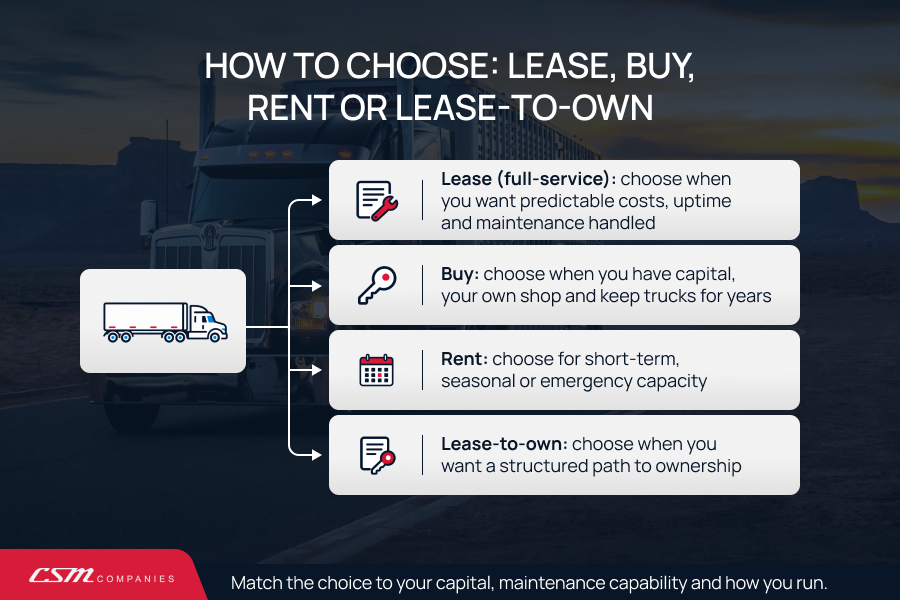
There is no universal winner between leasing and buying a semi-truck. The right choice follows your capital, your maintenance capability, and how you use the trucks. Use this as a quick decision framework.
Choose full-service truck leasing when:
- Preserving capital is important
- Predictable fleet costs matter
- Outsourcing maintenance is valuable
- Uptime is a major operational priority
- You prefer to replace equipment on a regular cycle
Buying flips those priorities. You take on a bigger upfront commitment in exchange for equity and long-term control. Consider buying when:
- You want long-term asset ownership
- Capital is readily available
- The fleet has strong internal maintenance capabilities
- Trucks will stay in service for a long lifecycle
Consider semi-truck rental when your capacity needs are short-term, seasonal or unpredictable. Consider lease-to-own when eventual ownership matters but you prefer a structured path toward purchasing.
Leasing vs buying a semi-truck is, in the end, a cost-and-control decision. Price out the total cost of each option over the life of the truck, weigh how much you value ownership against predictable uptime, and match the structure to how you operate.