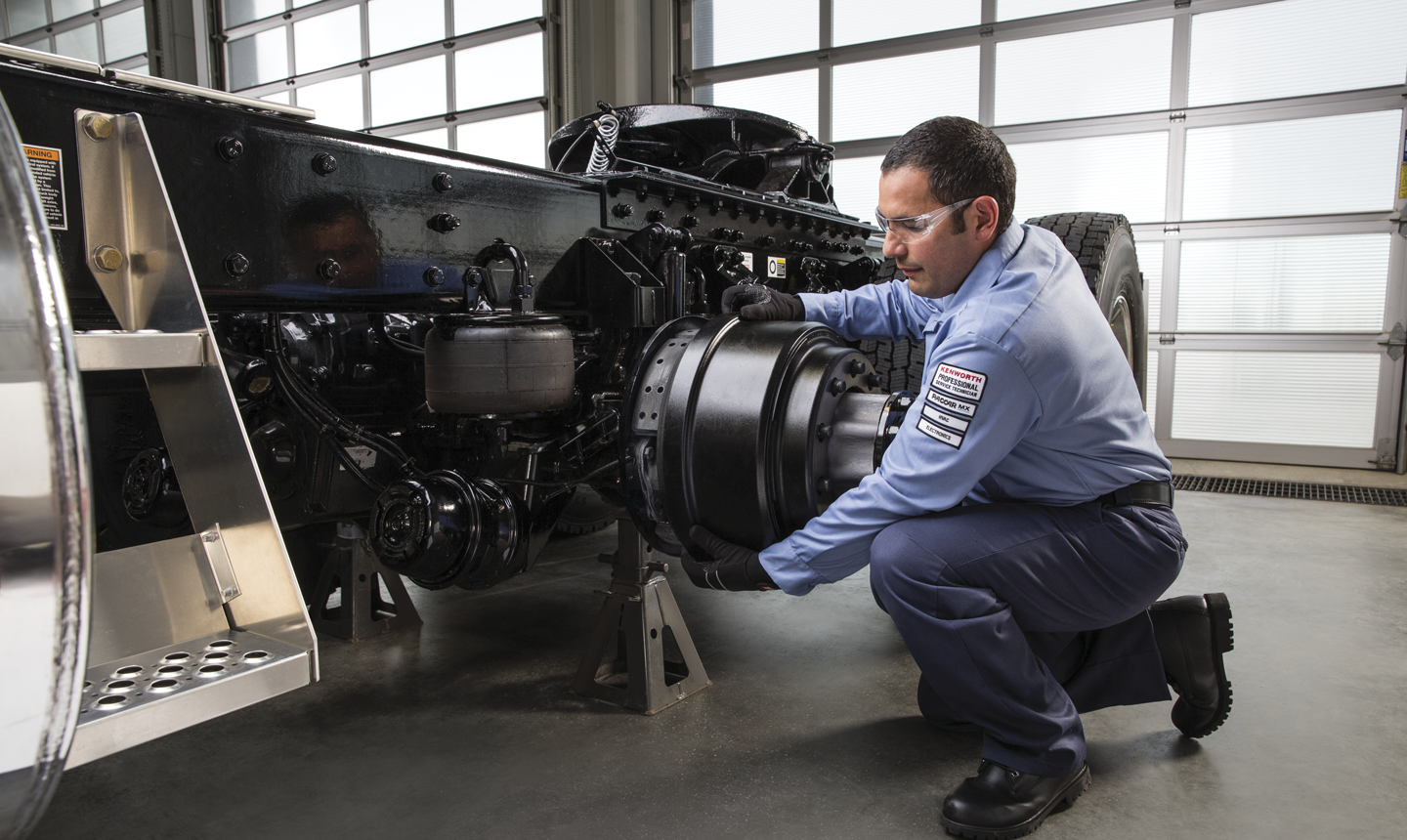
What Is Fleet Maintenance and Why Does It Matter

Fleet Maintenance: Key Facts
Fleet maintenance is the ongoing program of inspection, preventive service, and repair that keeps a fleet of commercial trucks safe, compliant, and on the road. It’s built around the work each truck does rather than left to chance. This matters because a parked truck earns nothing, and the cost of keeping trucks running keeps climbing. In fact, the repair and maintenance cost of running a truck rose 8.6% per mile in 2025 and is up 45% since 2019, according to the American Transportation Research Institute. A real maintenance program is how you keep that cost under control.
At CSM Companies, we help fleets build and run a complete fleet maintenance program. That covers preventive service, DOT inspections, parts, and managed fleet support, with OEM-trained technicians across six states. That work is backed by a network of more than 30 locations and a three-time Kenworth Dealer of the Year.
- What it is: scheduled inspection, preventive service, and repair across a group of commercial trucks, tracked and documented.
- The three approaches: preventive (planned), reactive (fix on failure) and predictive (data-driven).
- Why it matters: uptime, DOT compliance, lower cost per mile, and stronger resale value.
- What it is not: an oil-change reminder. On a Class 8 truck, it’s a compliance and revenue system.
- Where CSM fits: preventive programs, DOT inspections, PACCAR parts, and Dedicated Fleet Services for managed operations.
What Fleet Maintenance Covers on a Commercial Truck
Fleet maintenance is easy to define and easy to underestimate. On a passenger car it’s a service light on the dash; on a commercial fleet it’s a system that keeps trucks legal, safe and earning across a whole operation.
On a Class 8 tractor or a medium-duty straight truck, the program covers the powertrain, brakes and chassis, the aftertreatment system, tires, electrical and the safety items a roadside inspector will check. Federal rules require every carrier to systematically inspect, repair and maintain the trucks it runs under FMCSA Part 396, so this isn’t optional. It’s the price of operating the equipment.
The difference between a real program and a paper one shows up in cost per mile, in your safety scores, and in how many trucks are available when the week starts. That’s why we treat fleet maintenance as an operations decision, not a line item to trim.
Preventive vs. Reactive vs. Predictive Fleet Maintenance
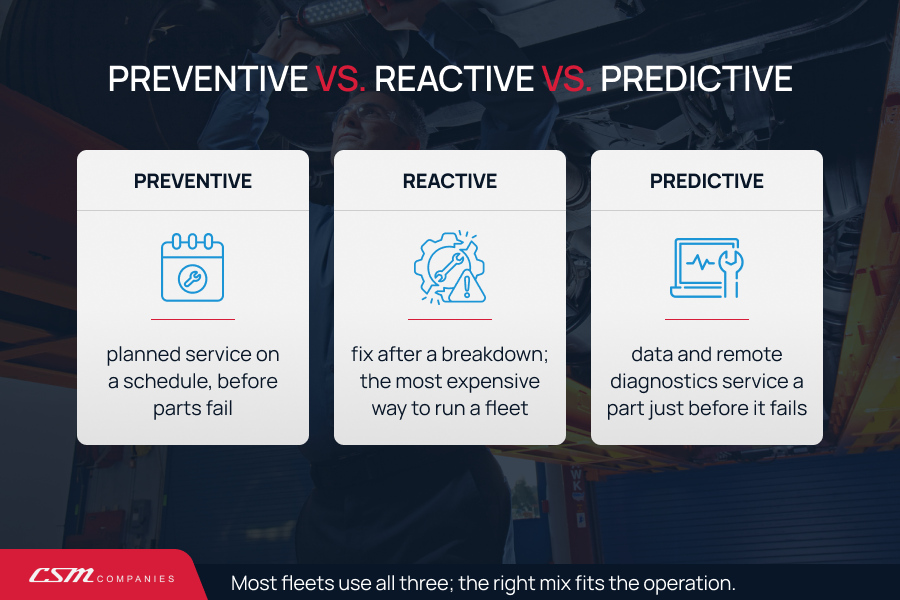
Every fleet uses a mix of three approaches. The right mix depends on your trucks, routes, and budget, which is a conversation, not a template.
Preventive Maintenance
Preventive maintenance is a planned service at set mileage or time intervals, before parts fail. It covers oil and filters, brakes, lubrication, and scheduled inspections. Servicing a truck on schedule is a small, predictable cost, and it catches worn parts before they fail on the road. That is why preventive maintenance is the foundation of any serious fleet program.
Reactive Maintenance
Reactive maintenance is essentially fixing a truck when it breaks. It’s perfect for minor, low-risk items. However, as a strategy, it’s the most expensive way to run a fleet, because a roadside failure adds a tow, lost freight, and an emergency repair rate on top of the cost of the part.
Predictive Maintenance
Predictive maintenance means using the truck’s sensor and diagnostic data to catch a part that is wearing out, so you can replace it just before it fails. Telematics and remote diagnostics such as Kenworth TruckTech+ flag a fault while the truck is still moving. You can then schedule the fix into a planned route instead of waiting for a breakdown. Predictive maintenance doesn’t replace preventive maintenance. It makes it more precise.
Why Fleet Maintenance Matters for Commercial Trucks
A truck creates value when it’s moving, not when it’s sitting in a bay, so maintenance is really about protecting revenue. A strong program protects five things at once:
- Uptime: planned service keeps trucks available and turns breakdowns into scheduled stops.
- Cost per mile: preventive work is cheaper than emergency repair, and it’s the line fleets can actually control as ATRI’s numbers keep climbing.
- Compliance and safety scores: clean DOT inspections keep trucks in service and protect your records under FMCSA’s CSA program.
- Safety: brakes, tires and steering maintained on schedule protect your drivers and everyone around them.
- Resale value: a documented maintenance history is worth real money when a truck rotates out of the fleet.
None of these are one-size-fits-all. A regional day-cab fleet and a long-haul sleeper fleet need different intervals, and matching the program to the operation is where the savings live.
How to Build a Fleet Maintenance Program
A program doesn’t have to be complicated, but it does have to be consistent. Three pieces make it work:
- Set schedules and keep records
- Use data and fleet maintenance software
- Decide in-house, outsourced, or both
Set Schedules and Keep Records
Define service intervals by mileage, engine hours and duty cycle, then document every inspection and repair. Records aren’t busywork; they’re what proves compliance at an audit and what protects resale value when the truck moves on.
Use Data and Fleet Maintenance Software
Fleet maintenance software or fleet management system tracks intervals, work orders and parts, and pairs with telematics to catch faults early. Software organizes the program, but it doesn’t turn a wrench, so the tool is only as good as the shop and the schedule behind it.
Decide In-House, Outsourced or Both
Some fleets run their own shops, some outsource entirely, and many do both. The right answer depends on fleet size, location, and how much downtime you can absorb. A dealer service network gives you OEM-trained technicians and parts without the overhead of building a shop in every market you run.
What a Fleet Maintenance Schedule Should Track
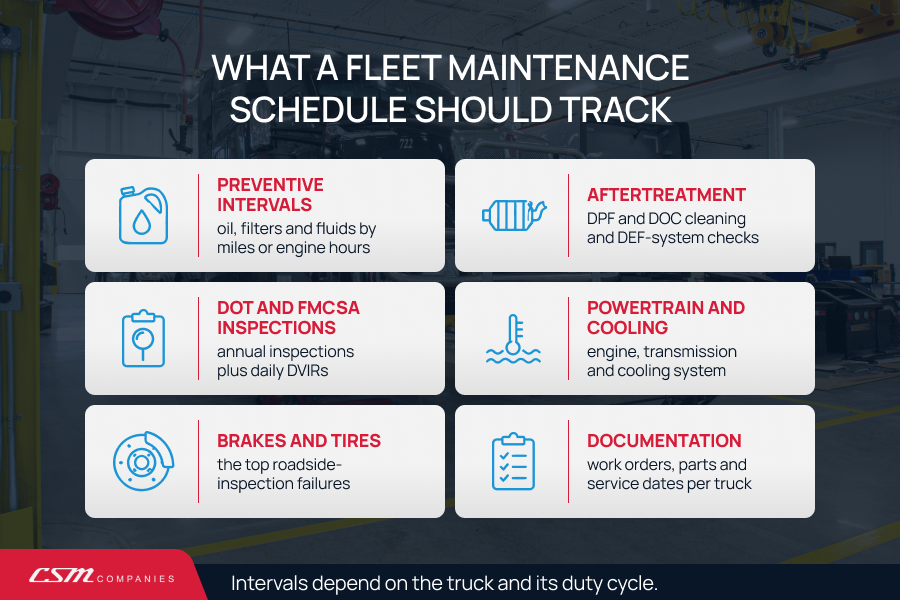
A schedule turns good intentions into a system. At minimum, track:
- Preventive service intervals: oil, filters, lubrication, and fluids by mileage or engine hours.
- DOT and FMCSA inspections: annual inspections and daily driver vehicle inspection reports.
- Brakes and tires: the wear items that fail roadside inspections most often.
- Aftertreatment service: DPF and DOC cleaning and DEF system checks.
- Powertrain and cooling: engine, transmission, and cooling system maintenance.
- Documentation: work orders, parts used, and service dates for every truck.
The exact intervals depend on the truck and the work it does, which is why our technicians read each unit’s history and duty cycle rather than applying one blanket schedule across the fleet.
How to Reduce Fleet Maintenance Costs and Downtime
Lower cost and lower downtime come from the same place: doing the right work at the right time. A few levers move the needle most:
- Shift spend toward preventive service, because every planned repair avoids a costlier emergency one.
- Keep genuine parts within reach, since fast access to the right part is a direct lever on downtime, not a convenience.
- Use remote diagnostics to catch faults before they sideline a truck.
- Standardize intervals and keep clean records to cut surprises and protect resale value.
- Lean on a service partner in the markets where you don’t run a shop, so a breakdown far from home is still a planned repair wherever you operate.
The cheapest invoice isn’t always the lowest total cost. Weigh the repair against the downtime it prevents, because uptime is where a fleet actually makes its money.
How CSM Companies Keeps Commercial Fleets Moving
At CSM Companies, fleet maintenance is a core part of what we do, not an afterthought. We help fleets of every size build a preventive program, stay ahead of DOT compliance, and keep trucks earning across our network.
Our service centers run scheduled preventive maintenance and full DOT inspections with OEM-trained technicians, and Kenworth ExpressLane Triage moves trucks through faster when time matters. For fleets that would rather have the work managed for them, Dedicated Fleet Services handles maintenance operations end to end in Wisconsin and Ohio.
Behind the service is a deep PACCAR parts inventory and remote diagnostics, so common repairs don’t wait on a back-ordered part and faults get caught early. Prompt parts access is one of the biggest levers we have on your downtime.
Most of all, we build the program around your operation, from a handful of regional trucks to a mixed long-haul fleet, because the right maintenance plan is the one that fits how you actually run.
Fleet maintenance is the discipline that decides whether your trucks are earning on Monday morning or waiting for a part. Build it around preventive service, track it, use data to sharpen it, and treat it as the revenue system it is rather than a cost to trim. CSM Companies helps commercial fleets do exactly that, with preventive programs, DOT compliance, PACCAR parts and managed fleet support across more than 30 locations in six states. Tell us how your fleet runs, and we’ll help you build a maintenance program that keeps it moving.