Diesel Gelling: At What Temperature Does Diesel Gel and How to Prevent It
Diesel gelling is a cold-weather problem: paraffin wax forms crystals that can plug the fuel filter and strand a truck. There is no universal gel point, so the fix is prevention. Three things keep a fleet running through winter: the right diesel anti-gel, winter-grade fuel, and water management. Put them in place before the cold arrives, not in the middle of a cold snap. CSM stocks winter truck parts across locations in Wisconsin, Michigan, Ohio, and Nebraska.
What Is Diesel Fuel Gelling?
Diesel fuel gelling is when the paraffin wax dissolved in diesel crystallizes in the cold. While the fuel is warm, the wax stays dissolved, and the diesel flows normally. As it cools, wax crystals form, grow, and collect until they plug the fuel filter and starve the engine.
People use “gelling” loosely for any cold-weather fuel problem. Three measurements describe it more precisely, each defined by an ASTM test method: cloud point, the Cold Filter Plugging Point (CFPP), and pour point. The chart section below explains each one.
One distinction matters too: wax gelling is not the same as fuel-filter icing, which is water in the fuel freezing. Both plug a filter, but they call for different fixes.
At What Temperature Does Diesel Fuel Gel?
There is no single temperature at which diesel always gels. Untreated No. 2 diesel commonly shows wax crystals somewhere around 10°F to 32°F, depending on the batch, region, blend, and biodiesel content. The point at which a truck actually stops is usually colder than the cloud point and is better described by the Cold Filter Plugging Point.
Because the number moves so much, treat gelling as a risk to prepare for, not a threshold to wait on. The gel point shifts with fuel formulation (No. 1 vs No. 2), seasonal blending, biodiesel content, the supplier and region, additives and water contamination. Higher biodiesel blends can form wax well above 0°F, so prepare before an extreme-cold event, not during one.
Diesel Fuel Gelling Temperature Chart
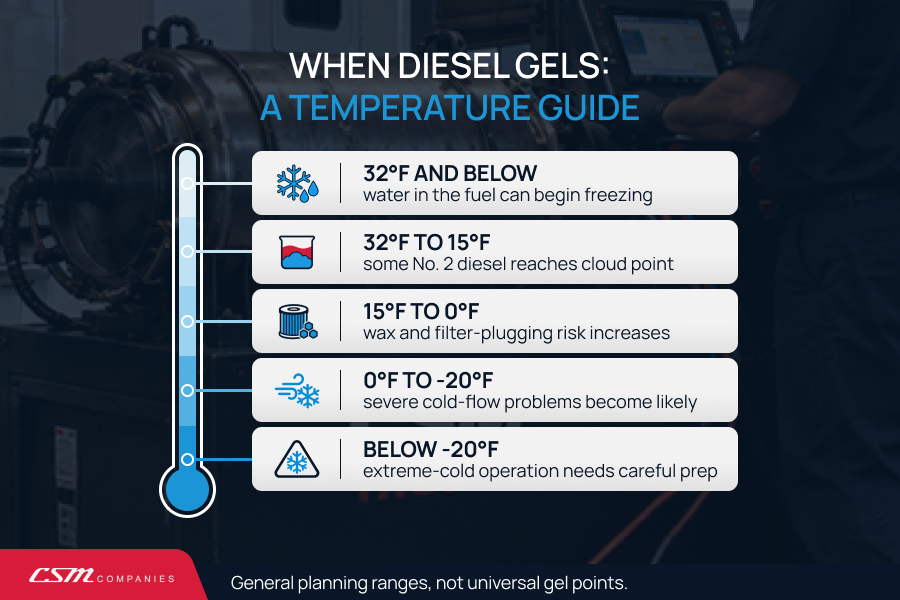
Use the chart as a planning guide for what can happen and what to do at each stage:
| Approx. Temperature | Recommended Fleet Action |
|---|---|
| 32°F and below | Drain water separators and inspect filters |
| 32°F to 15°F | Use winterized fuel and treat with anti-gel before clouding |
| 15°F to 0°F | Confirm winter blend, anti-gel treatment and spare filters |
| 0°F to -20°F | Use fuel suited to local conditions and follow supplier and OEM guidance |
| Below -20°F | Monitor fuel specification, heaters, batteries and filtration closely |
These temperatures are general planning ranges, not universal gel points. Diesel cold-flow performance varies by fuel batch and specification.
Three terms describe the chart. The cloud point is when wax crystals first appear, the earliest warning. The Cold Filter Plugging Point is when that wax stops fuel from passing through a standard filter, closer to where the truck quits. The pour point is the lowest temperature; the fuel still flows. A good rule of thumb: run fuel with a cloud point comfortably below your coldest expected temperature, often by around 10°F.
How Diesel Anti-Gel Additives Work
A diesel anti-gel, or cold-flow improver, changes how wax crystals form, so they stay small enough to pass through the fuel system in the cold. It does not remove the wax. It keeps the crystals from growing big enough to plug the filter.
Anti-gel is preventative. Mix it in while the diesel is still above its cloud point. Adding it after wax has formed will not usually reopen a plugged system. Follow, in order, the additive maker’s dosing instructions, the engine maker’s fuel recommendations, and the fuel supplier’s winter-fuel guidance.
There is no single universal best diesel anti-gel. Judge a product by what it does. The things that matter most are compatibility with ULSD and your biodiesel blend, documented CFPP improvement, the correct treatment ratio, water or de-icing capability where needed, OEM approvals, and fleet-sized packaging.
When Should You Add Anti-Gel to Diesel?
Begin treating fuel before the forecast approaches the cloud point, not after the truck loses power. For Upper Midwest fleets, finish winter fuel prep well before the first hard November cold snap. CSM stocks the additive, emergency treatments, and fuel filters for fleets. Parts counters across the Wisconsin, Michigan, Ohio, and Nebraska locations carry winter-ready stock, so you can treat a whole fleet before the forecast turns rather than chase supply once the cold hits

How to Prevent Diesel Fuel Gelling
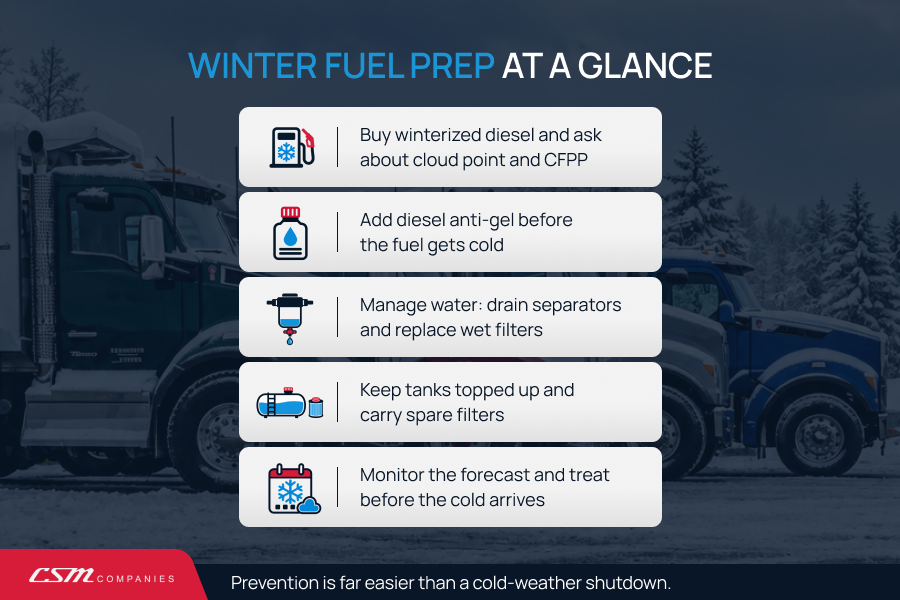
Preventing diesel gelling comes down to the right fuel, additive, and water control, all before the cold arrives:
1. Buy winterized diesel from a reliable supplier, and still ask about the cloud point, CFPP, the No. 1/No. 2 blend, biodiesel percentage, and minimum operating temperature.
2. Add diesel anti-gel before the fuel gets cold, while it is still warm enough for the additive to disperse, and follow the dosage directions.
3. Manage water in the fuel system: drain water separators, inspect bulk storage, watch for condensation, and replace any filter that has taken on water.
4. Keep fuel tanks topped up to reduce headspace and condensation during severe temperature swings.
5. Use the correct seasonal fuel. No. 1 and winterized No. 2 blends flow colder. The right fuel depends on climate, engine guidance, and supplier specifications, so there is no universal ratio.
6. Carry spare fuel filters, since a wax- or ice-plugged filter is often the immediate cause of a cold-weather shutdown.
7. Monitor the local forecast and start winter procedures before sustained freezing sets in.
What Happens When a Diesel Fuel Filter Gels or Freezes?
A fuel filter shows it before the whole tank looks solid. Watch for hard starting, an engine that starts then stalls, loss of power or surging, reduced fuel pressure, a no-restart, or a filter that looks waxed or plugged.
Two causes produce those symptoms. Wax plugging happens when paraffin crystals restrict the filter as fuel reaches its cold-flow limit. A cold-flow improver and winter fuel prevent it. Ice plugging happens when water freezes at or below 32°F. Water separators, clean filters, and a de-icer address it. Water can plug a filter even before wax gelling does, so check the filter and water separator first.
Do Block Heaters Prevent Diesel Gelling?
Block heaters don’t prevent diesel gelling on their own. A block heater warms the engine for easier starting. It does not keep the diesel in the tank, lines, and filter above its cloud or plugging point. That makes it no substitute for winter fuel and anti-gel. Fuel-filter, fuel-line, and tank heaters target the fuel system where gelling happens. Together they are one part of a winter-readiness plan, alongside correct fuel, anti-gel, and regular service.
What to Do If Your Diesel Fuel Has Already Gelled
Once the fuel system is already plugged, ordinary preventative anti-gel is not an emergency repair. Instead:
- Move the vehicle somewhere safe.
- Confirm whether the problem is wax, ice, or another issue.
- Warm the fuel system where practical.
- Inspect or replace the plugged filters per the service procedure.
- Use an emergency degelling or de-icing product only as directed.
- Treat the restored fuel for continued cold-weather operation.
Never use open flames or torches to thaw a fuel system. Prevention is far easier than recovering a disabled truck in a cold snap.
Can You Add Anti-Gel After Diesel Has Gelled?
Not the preventative kind. It needs to go in before the fuel reaches its cloud point. After a shutdown, you generally need a product made specifically to reliquefy gelled fuel or de-ice the filter. These are emergency degel and de-icer products, built to restore flow rather than prevent gelling. CSM keeps them on the shelf alongside spare filters, so a stranded truck can be treated and back on the road quickly.
Winter Diesel Prep Checklist for Commercial Trucks
Run this diesel prep checklist before winter and whenever a hard cold snap is forecast:
Fuel
- Confirm winter-grade diesel is available
- Ask the supplier about cloud point and CFPP
- Verify the biodiesel content
- Stock diesel anti-gel and an emergency treatment
- Treat the fuel before it reaches cloud point
Fuel System
- Replace overdue fuel filters and carry spares
- Drain the water separator
- Inspect fuel lines and the filter heater
- Check for fuel leaks
Starting and Heating
- Load-test batteries and clean connections
- Test the block heater and cord
- Verify the coolant heater
- Test the cab heater and defroster
Fluids, Tires and Emergency Kit
- Check coolant freeze protection, winter oil, and washer fluid
- Set tire pressure and tread depth
- Carry gloves, a flashlight, jumper gear, and a roadside kit
Best Practices for Wisconsin, Michigan, Ohio and Nebraska Fleets
Fleets in Wisconsin, Michigan, Ohio, and Nebraska face rapid temperature drops, sub-zero overnight lows, variable winter-fuel blends, and trucks parked outside. Watch one scenario. A truck can be fueled in a warmer region with a higher cloud-point diesel. It then drives north into sub-zero conditions, where that fuel may no longer be suitable.
A simple timeline keeps preparation ahead of the weather:
- September to October: review winter PM, test batteries and heaters, and order additives, filters, and winter parts.
- Late October to early November: confirm the winter fuel program, begin weather-triggered treatment, and stock trucks and service locations.
- November to March: watch forecasts, verify fuel specs, maintain water separators and filters, and tighten procedures as temperatures fall. CSM locations can help fleets stock up before demand spikes. With parts counters in Wisconsin, Michigan, Ohio, and Nebraska, CSM keeps winter-grade additives, emergency treatments, filters, and heaters stocked through the season. The team can also help you set up a standing winter parts order, so your trucks and service bays are supplied before the first hard freeze.
Where to Buy Diesel Anti-Gel and Winter Truck Parts
Stock winter consumables before a major cold-weather event creates urgent demand. Keep on hand diesel anti-gel and emergency treatment, fuel filters and water separators, block and fuel heaters, batteries and coolant, winter washer fluid and wiper blades, and air-system components.
CSM carries these winter truck parts across Wisconsin, Michigan, Ohio, and Nebraska. Prepare before temperatures drop: visit a CSM location for diesel anti-gel, fuel filters, batteries, heaters, and other winter parts.


