Dump Truck Sizes and Capacity: Tri-Axle Dump Truck, Tandem and More
Last updated November 2026.
Dump Truck Sizes and Capacity
A tri-axle dump truck’s capacity depends on two things: the dump body’s volume in cubic yards and the payload the truck can legally carry on its route. The same truck can fill its body with mulch but reach its weight limit before the body is full of gravel.
Dump Truck Types and Capacity by Axle Configuration
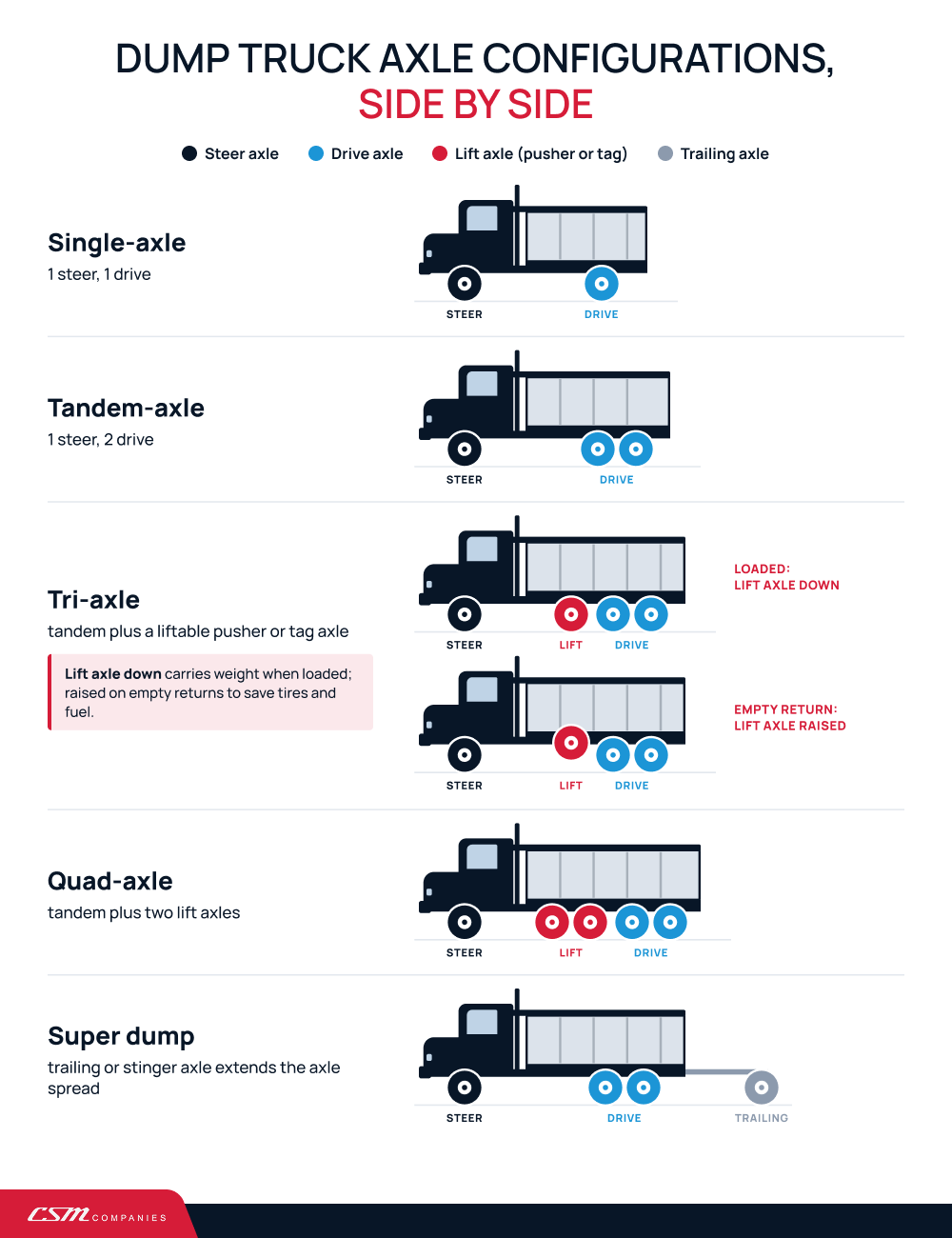
Dump trucks are grouped by how many axles carry the load, because axles decide legal weight, and more axles spread that weight across more of the road.
A single-axle dump carries about 5 to 10 cubic yards and suits landscaping and tight residential sites. A tandem-axle adds a second drive axle and is the general construction workhorse at 10 to 16 cubic yards.
A tri-axle adds a liftable pusher or tag axle and is the aggregate and excavation standard at 16 to 20 cubic yards. Its lift axle drops to carry weight when the truck is loaded and raises on empty returns to save tires and fuel.
A quad-axle adds a second lift axle for heavy aggregate at 18 to 24 cubic yards. A super dump uses a trailing axle that stretches the axle spread to carry the most legal weight of any straight dump truck.
Transfer, side, and end dump trailers add volume for high-volume hauling, while articulated dumps are off-road machines rather than on-highway trucks.
The chart below lines up each configuration by body size, legal payload, weight class, and typical work. Treat the figures as general planning ranges, since the legal payload in particular depends on your state:
| Type | Body (cubic yards) | Legal payload (tons)* | Typical GVWR | Typical jobs |
|---|---|---|---|---|
| Single-axle | 5 to 10 | 6 to 9 | Class 7 to 8 | Landscaping, small residential |
| Tandem-axle | 10 to 16 | 13 to 15 | Class 8 | General construction, aggregate |
| Tri-axle | 16 to 20 | 15 to 21 | Class 8 | Excavation, aggregate, asphalt |
| Quad-axle | 18 to 24 | 20 to 25 | Class 8 | Heavy aggregate, high-volume |
| Super dump | 20 to 26 | Up to 26+ | Class 8 | Maximum legal-load hauling |
*Legal payload depends on your state’s axle-weight and Bridge Formula limits, so these are general planning ranges, not guarantees. Body sizes vary by body maker. Confirm legal weights with your state DOT before you load.

How Many Yards and Tons Does a Tri-Axle Dump Truck Hold?
A tri-axle dump truck holds about 16 to 20 cubic yards by volume and hauls about 15 to 21 tons of legal payload, and it is the tonnage, not the body size, that governs most loads. Body ratings are usually quoted heaped, mounded above the sides, but a dense load tops out the legal weight before the body ever looks full, so weight is the real limit. Body maker and material shift the numbers too, since an aluminum body frees up payload while a steel body trades weight for durability on abrasive loads.
The legal payload itself varies by state. The per-axle federal caps are set in 23 CFR 658.17, and many states allow more under permits or grandfather rights, so confirm your number with your state DOT. The lift axle is what turns a tandem into a legal tri-axle load. Lowered and aired up, it adds a weight-bearing axle and raises the payload. When it’s raised, only the tandem axles carry the load, so the truck is held to tandem weight limits until the axle comes back down.
Dump Truck Weight and Legal Limits: GVWR, Axle Weights, and the Bridge Formula
Payload is governed by legal weight, not body size, and every pound of truck is a pound off the load, so a heavier steel body or an added axle lowers what you can haul. The federal baseline in 23 CFR 658.17 is 20,000 pounds on a single axle, 34,000 on a tandem, and 80,000 gross on the Interstate system.
On top of those caps, the Federal Bridge Formula sets how much a group of axles can carry from how far apart they sit. The formula is W = 500 x (LN/(N-1) + 12N + 36). A wider spread between the outer axles allows more weight, which is why a super dump with trailing axles can legally outhaul a shorter truck of the same class. States adjust from there with permits, grandfather rights, and spring thaw limits, so confirm the legal weight for your route and season before you load.
How Much Dirt, Gravel, and Sand Does a Dump Truck Hold?
The same truck holds a very different tonnage of each material, because density changes what a cubic yard weighs. The table below gives general planning weights per cubic yard.
| Material | Approx. weight per cubic yard | Approx. tons per cubic yard |
|---|---|---|
| Mulch | 400 to 800 lbs | 0.2 to 0.4 |
| Topsoil (dry) | 2,000 to 2,700 lbs | 1.0 to 1.35 |
| Fill dirt | 2,000 to 2,700 lbs | 1.0 to 1.35 |
| Sand (dry) | 2,400 to 2,900 lbs | 1.2 to 1.45 |
| Crushed stone | 2,700 to 3,000 lbs | 1.35 to 1.5 |
| Gravel | 2,800 to 3,400 lbs | 1.4 to 1.7 |
| Asphalt | 3,700 to 4,100 lbs | 1.85 to 2.05 |
Densities vary with moisture and compaction, so these are general planning figures. Confirm the weight of a specific material with your supplier.
In practice, the gap is easy to see. A tri-axle with a 17-cubic-yard body that is legal for about 18 tons fills to only about 12 yards of gravel, because at roughly 1.5 tons per cubic yard the weight limit arrives first. The same body takes a full 17 yards of mulch at about 0.3 tons per cubic yard and is still only about 5 tons, far under the limit. Heavy materials fill by weight, and light materials fill by volume.
Best Dump Truck Spec for Each Job
The right dump truck carries the most legal payload for your material and routes without paying for axles you will not load. Landscaping and residential work suit a single-axle or small tandem, where maneuverability on tight lots matters more than maximum tons.
Excavation and site work favor a tandem or tri-axle with a steel body that shrugs off rock and debris. Aggregate and asphalt paving reward the maximum legal payload of a tri-axle or quad-axle to cut trips per load. Paving crews add an insulated body to hold asphalt heat. Municipal fleets often spec a tandem built to add a plow and spreader for winter.
Beyond axles, match the engine, such as the PACCAR MX-13 or Cummins X15, the transmission, the body material, and the steer-axle position to the balance that the job needs.
Kenworth T880 and Mack Granite Dump Truck Builds at CSM Truck
CSM builds and stocks dump trucks on two proven Class 8 vocational platforms. The Kenworth T880 is Kenworth’s vocational flagship, built in tandem, tri-axle, and quad-axle configurations. Buyers can spec a set-forward or set-back steer axle, pusher or tag lift axles, and PACCAR MX-13 or Cummins X15 power.
The Mack Granite is a longtime construction and aggregate staple, built in tandem, tri-axle, and quad-axle configurations with Mack MP power and a choice of body makers.
Mack redesigned the Granite in 2026 with a new cab and an updated MP13 engine rated up to 540 horsepower. Ask the CSM team which Granite generation fits your order timing.
Frequently Asked Questions About Dump Truck Sizes
Quick answers to the questions contractors and haulers ask most:
How many tons does a tri-axle dump truck hold?
A tri-axle dump truck holds about 15 to 21 tons of legal payload, depending on your state and axle spacing. The figure is a legal weight limit, so confirm the exact number with your state DOT.
What is a tri-axle dump truck?
A tri-axle dump truck has three axles at the rear: two drive axles plus a liftable pusher or tag axle. Counting the steer axle, it rides on four axles in total. The lift axle comes down to carry weight when the truck is loaded and goes up to save tires and fuel when it runs empty. A truck with only a steer axle and two drive axles is a tandem, which some people call a 3-axle dump truck.
How much does a new tri-axle dump truck cost?
Price depends heavily on the chassis, body, and axle package, so a single number is not reliable. For current pricing on a build that fits your work, request a quote from the CSM vocational team.
How much dirt does a dump truck hold?
By volume, a tri-axle holds about 16 to 20 cubic yards. By weight, fill dirt runs about 1.0 to 1.35 tons per cubic yard, so a tri-axle usually reaches its legal weight limit before the body is full.
Do you need a CDL to drive a dump truck?
Most dump trucks are rated well above 26,000 pounds, so yes, most require a commercial driver’s license. Under 49 CFR 383.91, a single truck rated at 26,001 pounds or more needs a Class B CDL. A Class A is required if the truck tows a trailer rated over 10,000 pounds, such as a push or transfer trailer.


