
Engine Brake: Key Facts
On a long mountain descent, an engine brake uses the truck’s own diesel engine to slow it down, holding the service brakes in reserve for when they are truly needed. It is one of the most effective tools a driver has for controlling speed, protecting brake life, and staying off the runaway ramp. CSM Companies has serviced Kenworth drivetrains for more than 45 years, and our factory-trained technicians check the system closely on every T680 and W990 that comes through our bays.
Engine brakes at a glance:
• Function: uses the engine to slow the truck independently of the service brakes.
• Primary types: the compression-release brake, known as the Jake Brake, and the exhaust brake.
• How it works: converts engine compression into braking force instead of relying on friction at the wheels.
• Primary benefit: maintains speed control on long descents while reducing brake fade.
• Long-term value: extends service brake life, improves control, and lowers maintenance cost.
How Does an Engine Brake Work
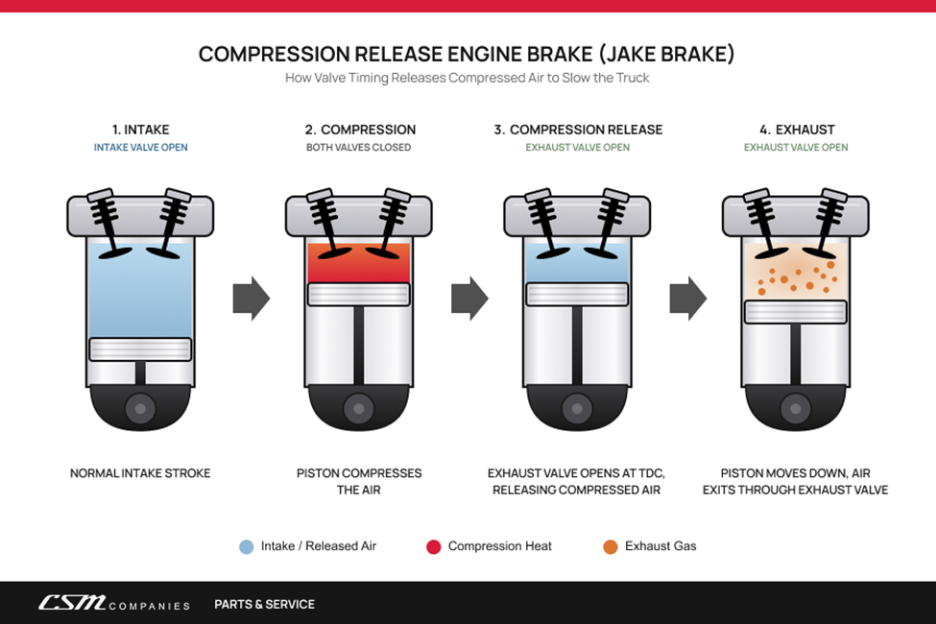
A diesel normally stores energy on the compression stroke. The piston compresses air, and that compressed air pushes back as the piston descends, returning most of the energy to the crankshaft.
A compression-release brake interrupts that exchange. Near the top of the compression stroke it opens the exhaust valves and releases the compressed air into the exhaust, so the energy the engine just spent on compression is discarded rather than returned. Instead of driving the truck forward, the engine works against its own momentum.
Repeated across all six cylinders thousands of times a minute, the effect is substantial slowing power, along with the distinctive engine-brake sound.
An exhaust brake operates differently, restricting the exhaust outlet to build backpressure against the pistons. It is quieter and simpler, and common on medium-duty trucks, though it produces less slowing force than a compression-release unit.
Types of Engine Brakes Used in Trucks
Three types cover most of what is on the road.
Compression-Release Brakes (Jake Brakes)
The compression-release brake, widely known as the Jake Brake, is the standard on Class 8 diesel trucks. Introduced by Jacobs Vehicle Systems in 1961, it produces the strongest engine braking, controlling speed on steep descents while reducing reliance on the service brakes. On the Kenworth trucks CSM Companies sells and services, we pair these brakes with the PACCAR MX-13 engine and PACCAR Powertrain to hold speed on long grades.
Exhaust Brakes
An exhaust brake restricts exhaust flow to create backpressure. Simpler than a compression-release brake, it is common on medium-duty trucks such as the Kenworth T280 and the Hino models in CSM Companies’ inventory. It will not control a heavy load on a steep grade as effectively as a Jake Brake, but it still reduces service brake wear.
Engine Brakes vs. Transmission Retarders
Some trucks add a driveline or transmission retarder, which slows the truck through the driveline rather than the engine. A retarder and a compression brake do similar work and are sometimes fitted together; the right combination depends on the routes and loads a truck runs. Talk to a CSM Companies spec specialist about which setup fits your fleet.
Benefits of Using an Engine Brake
For fleets running mountain routes, the payoff shows up on the first long descent rather than on the spec sheet. It comes down to brake life, control and time on the road:
• Longer brake life: the engine does the slowing, so the service brakes wear far more slowly.
• Less brake fade: on long descents, friction brakes overheat and fade, while engine braking keeps them cool and ready.
• Better control: steady, predictable deceleration on grades and traffic.
• Lower cost and downtime: fewer brake jobs mean more uptime and less time in the shop.
• Safety margin: more stopping capacity held in reserve for the moment it is needed.
“The trucks that come in with worn-out brakes are almost always the ones running grades without the engine brake engaged,” says a CSM Companies service manager. “It is the cheapest insurance you have against a brake job.”
Engine Brake vs Service Brake: Key Differences
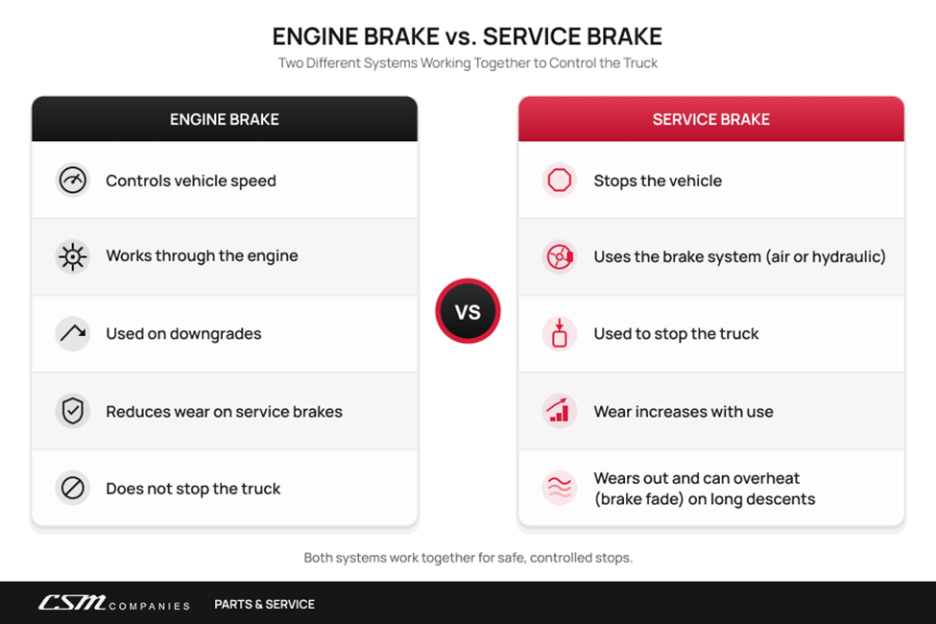
The distinction is simple: service brakes stop the truck, and the engine brake controls its speed. Service brakes create friction at the wheels to bring the truck to a halt, generating heat and wear as they do.
An engine brake, by contrast, is supplemental: it slows the truck without friction or wear, which suits holding speed down a grade or easing off in traffic, but it cannot bring the truck to a complete stop. Used together, they split the work: the engine brake carries the load on descents, and the service brakes stay fresh for stopping.
Brakes wearing out too fast? Book brake and driveline service with CSM Companies.
When and How to Use an Engine Brake Safely
Use the engine brake on downgrades and any time you want to shed speed without riding the service brakes. Engage it before starting down a grade and select a low enough gear. The advice our technicians give new drivers is simple: descend a hill in the same gear you would need to climb it and let the engine brake hold you there.
Many heavy-duty engine brakes offer two or three stages, letting a driver match braking force to conditions.
On wet, icy or loose surfaces, aggressive engine braking can reduce traction at the drive wheels, which is why many drivers lower the stage or switch it off in low-traction conditions; modern systems also coordinate with ABS to maintain stability.
Respect posted “no engine braking” signs near towns, which target noise from trucks with open or worn exhaust rather than the technology itself. Above all, do not rely on the engine brake to stop the truck. Its role is to preserve the service brakes, not to replace them.
Not sure which engine brake fits your routes? Talk to a CSM Companies spec specialist near you.
Common Myths About Engine Brakes
A few beliefs about these systems persist despite the facts. These are the ones our technicians hear most often in the shop:
• “They are illegal.” They are not. Restrictions apply to excessive noise from unmuffled engine brakes, not to the technology.
• “They damage the engine.” They do not. Compression-release and exhaust brakes are engineered for regular use.
• “They can stop the truck.” They cannot. They control speed; the service brakes bring the truck to a stop.
• “They are only for Class 8 trucks.” Not so. Compression-release units are mainly on Class 8 trucks, but exhaust brakes are common on medium-duty models.
FAQs About Engine Brakes
The questions drivers and fleets ask us most about engine brakes:
A system that uses the engine to slow a truck, separate from the wheel (service) brakes. The two common types are the compression-release brake, often called a Jake Brake, and the exhaust brake. It controls speed and saves the service brakes, but it does not bring the truck to a full stop
A compression-release unit opens the exhaust valves near the top of the compression stroke, dumping the air the engine just compressed. That spent energy is not returned to the piston, so the engine absorbs the truck’s momentum and slows it. An exhaust brake instead builds backpressure in the exhaust to resist the pistons.
The popular name for a compression-release brake, after Jacobs Vehicle Systems, which introduced it in 1961. It is the strongest type and the standard on most heavy-duty diesels, and the name is so common that many drivers use it for any engine brake.
No. They are built into the valvetrain and designed for frequent, hard use, so normal use does not shorten engine life. They remove work off the service brakes, reducing wear and fade and extending their service life.
The distinctive engine-brake sound comes from compressed air released through the exhaust on each cycle. With a working muffler it is manageable, but trucks with open or worn exhaust can be very loud, which is why some towns post “no engine braking” signs.
The technology is legal. Local “no engine braking” signs restrict noisy use in residential and quiet zones and target trucks without adequate mufflers. Obey the signs where they are posted.
On downgrades and any time you want to control speed without riding the service brakes. Engage it before a descent, select a low enough gear and let it hold your speed. Ease off or disengage it on icy or slick roads, where hard engine braking could cause the drive wheels to lose traction.
A compression-release unit releases compressed air through the exhaust valves and makes strong braking power, ideal for heavy loads and steep grades. An exhaust brake restricts the exhaust to build backpressure; it is lighter, quieter and common on medium-duty trucks, but it slows less aggressively. CSM Companies’ expert technicians can help you decide which setup best fits your truck.
Not directly. The main payoff is saving the service brakes and improving control, which lowers maintenance cost and downtime. By letting a driver carry speed safely on grades without overheating the brakes, it supports smoother driving overall.
Often, yes. Many diesel trucks can have a compression-release or exhaust brake added later, depending on the engine and setup. As a Kenworth dealer, CSM Companies can spec the right one for your Kenworth or mixed fleet and keep it running.
An engine brake earns its place on any truck that runs grades, and the difference between one that performs and one that becomes a noise complaint is maintenance. CSM Companies specs, installs and services engine brakes on Kenworth and mixed fleets, backed by factory-trained technicians at every location — from Wisconsin Kenworth to French Ellison Truck Center.
Shopping for your next truck? Browse CSM Companies’ new and used truck inventory.