


DPF vs DOC: Key Facts
When a truck keeps failing regens or throws an aftertreatment code, it is easy to blame the DPF, clean it, and move on, only to have the problem come back. Often the real cause sits further upstream, which is why the DPF vs DOC question is worth answering before you buy parts. Federal rules have required this emissions hardware on every on-highway diesel since the 2007 model year under EPA emissions standards, so understanding both components protects your repair budget and your uptime.
At CSM Companies, we help you find the true cause before replacing anything, diagnosing and servicing the full aftertreatment system with OEM-trained technicians. That work is backed by a service network across six states and a three-time Kenworth Dealer of the Year.
• DOC (diesel oxidation catalyst): a flow-through catalyst that oxidizes carbon monoxide and unburned fuel and generates the heat and gases the DPF needs to regenerate.
• DPF (diesel particulate filter): a wall-flow filter that physically traps soot and ash, then burns off the soot during regeneration.
• How they work together: exhaust passes through the DOC first, then the DPF, so the DOC’s job is what makes the DPF’s job possible.
• When they need cleaning: the DPF is cleaned at a mileage interval or by symptom, and the DOC is inspected and cleaned at the same time.
• Why diagnosis matters: a weak DOC can look exactly like a clogged DPF, so cleaning the filter alone may not fix the truck.
What Does a DPF Do?
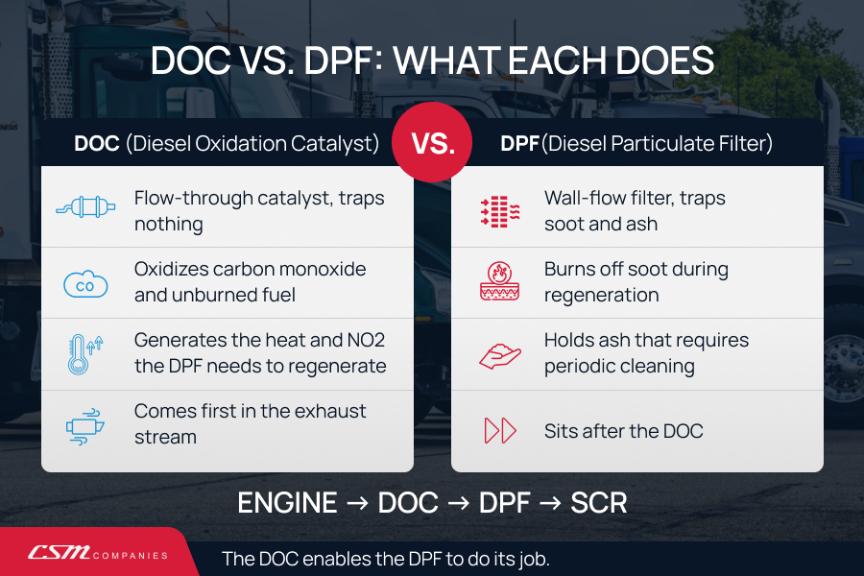
The diesel particulate filter is the component most owners know by name. It is a wall-flow filter that traps the fine soot in exhaust, so it does not leave the stack. Left unserviced, it restricts flow and can force a derate that caps road speed, so filter maintenance is really uptime maintenance.
Regeneration burns off the trapped soot, but the ash left behind by engine oil stays in the filter and builds with every mile. That ash is what eventually requires physical cleaning, even on a truck that regenerates normally.
This matters for one practical reason: a filter that is genuinely full of ash needs cleaning, but a filter that keeps clogging early is usually telling you something else is wrong. Reading that difference correctly is what keeps you from paying for the same job twice.
What Does a DOC Do?
The diesel oxidation catalyst sits ahead of the filter and does the quieter work. Unlike the DPF, it does not trap anything. It is a flow-through catalyst that oxidizes carbon monoxide and unburned hydrocarbons, and it generates the heat and nitrogen dioxide the filter relies on to regenerate.
In plain terms, the DOC is what lets the DPF clean itself. When the catalyst is healthy, exhaust reaches the temperature the filter needs to burn off soot. When it is fouled or aged, regenerations fall short and soot loads faster than it should.
That connection is the whole point of the DPF vs DOC comparison. Owners search it both ways, DPF vs DOC and DOC vs DPF, but the order does not change the answer: a truck with a struggling catalyst often shows up as a DPF problem, so cleaning the filter alone treats the symptom and leaves the cause in place.
“Half the DPF problems we see actually start at the DOC,” says CSM Companies service manager. “If the catalyst is not lighting off, the filter never gets hot enough to regenerate, and no amount of cleaning the DPF fixes that.”
Book an aftertreatment diagnosis at a CSM Companies service center near you.
When Do DPF and DOC Systems Need Cleaning
Aftertreatment service is driven by miles, duty cycle and symptoms, not a single date on the calendar. Here is how each component is handled.
The DPF
Most trucks need a DPF cleaning every 150,000 to 200,000 miles, following the engine maker’s service schedule. Heavy idling, short routes and stop-and-go work shortens that window. There is no universal number, though, which is why our technicians read each truck’s regen history and back pressure rather than applying a blanket interval.
The DOC
The catalyst is not on a fixed mileage schedule, but it should be removed, inspected and cleaned whenever the filter is serviced, using the same thermal and pneumatic methods. A DOC contaminated by an oil or coolant leak needs attention sooner, because coolant in particular can poison the catalyst quickly. Cleaning restores a healthy catalyst; one that is chemically poisoned or aged past its precious-metal life is replaced instead.
Schedule DPF and DOC service at a CSM Companies location near you.
Signs Your Aftertreatment System Needs Service
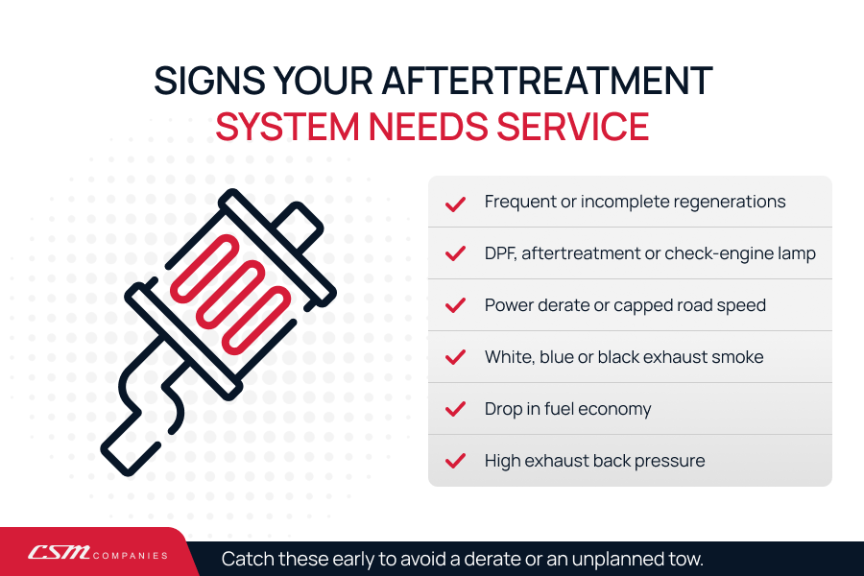
Most trucks warn you before a shutdown. Watch for these signs across the DOC and the DPF:
• Frequent, incomplete, or repeated parked-regeneration prompts.
• A DPF, aftertreatment, or check-engine lamp on the dash.
• A power derate or reduced road speed.
• White, blue, or black smoke from the stack.
• A drop in fuel economy over recent tanks.
• High exhaust back pressure found during service.
Catching these early is the difference between a scheduled cleaning and an unplanned tow. Telematics such as Kenworth TruckTech+ Remote Diagnostics can flag an aftertreatment fault before it sidelines the truck, so you can plan the repair around your routes.
Why Cleaning Alone May Not Fix the Problem
This is where many aftertreatment repairs go wrong. Cleaning the filter is the obvious move, but if the DPF was only a victim of something upstream, the truck will be back within weeks. These are the causes a cleaning alone will not touch:
• A fouled or aged DOC that cannot reach light-off temperature, so regens keep failing.
• A coolant, oil, or fuel leak contaminating the catalyst and the filter.
• A failed differential-pressure or temperature sensor reporting the wrong story.
• Excessive engine oil consumption loading the filter with ash prematurely.
• A DEF or SCR fault downstream that keeps forcing the system into regeneration.
Proper diagnosis looks at the whole aftertreatment path, not just the filter. Our technicians confirm whether the DOC is lighting off, whether the sensors are accurate, and whether an upstream leak is the real culprit before recommending a cleaning or a replacement. That way you spend once and the fix holds.
One route we steer owners away from is deleting or bypassing the hardware to make the codes go away. Federal law prohibits tampering with emissions equipment under the EPA anti-tampering policy, and current federal heavy-duty emissions rules hold every truck to it. A deleted system can put a truck out of service at roadside and void warranty coverage, so diagnosing the cause is the path that actually keeps the truck earning.
Find genuine DOC, DPF and aftertreatment parts through CSM Companies.
FAQs About DPF vs DOC
The questions owner-operators and fleets ask most about the difference between a DOC and a DPF and when each needs service:
The DOC is a flow-through catalyst that oxidizes gases and heats the exhaust; the DPF is a filter that physically traps soot and ash. They sit in series and depend on each other.
Yes. The catalyst should be removed, inspected and cleaned whenever the filter is serviced, using the same thermal and pneumatic methods.
It is the first catalyst in the aftertreatment system, oxidizing carbon monoxide and unburned fuel and generating the heat and nitrogen dioxide the DPF needs to regenerate.
Yes. A catalyst that cannot reach light-off temperature stops the filter from regenerating, which loads it with soot and mimics a DPF fault.
Typically every 150,000 to 200,000 miles, or sooner with heavy idling, short routes, or frequent regens.
A diagnosis that checks regeneration temperatures, sensor data, and back pressure tells you which component is actually at fault.
Yes, when the catalyst is poisoned by coolant or oil or has aged past its precious-metal life.
No. Federal law prohibits removing emissions equipment, and it can put a truck out of service and void warranty coverage.
Oil, fuel, or coolant contamination, heavy idling that plugs the inlet face, and exhaust leaks that rob it of heat.
CSM Companies diagnoses and services the full aftertreatment system across more than 30 locations in six states.
The DPF vs DOC distinction comes down to this: the filter traps, the catalyst enables, and the two fail in ways that look alike from the driver’s seat. Before you clean or replace a filter, it is worth confirming the DOC and the sensors around it are doing their job, because the cheapest repair is the one you only make once. CSM Companies diagnoses and services the complete aftertreatment system, DOC and DPF, with OEM-trained technicians across more than 30 locations in six states. Send your truck details and fault codes, and we will help you find the real cause at a location near you.
Get to the root cause with the CSM Companies aftertreatment team.