
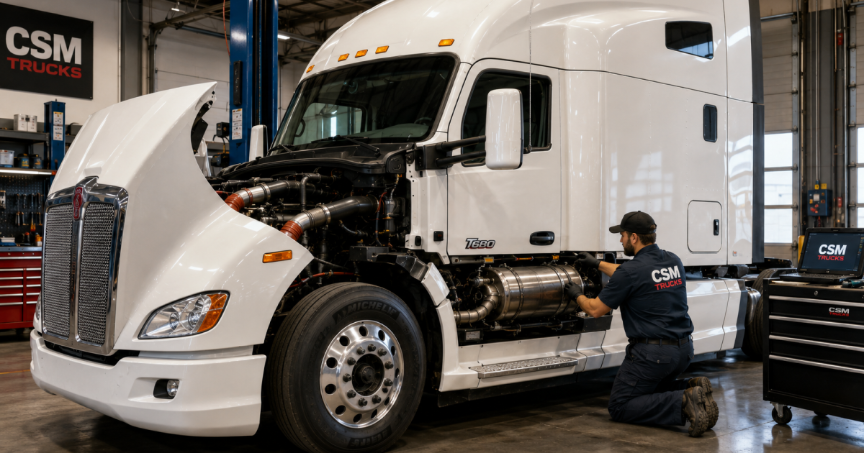
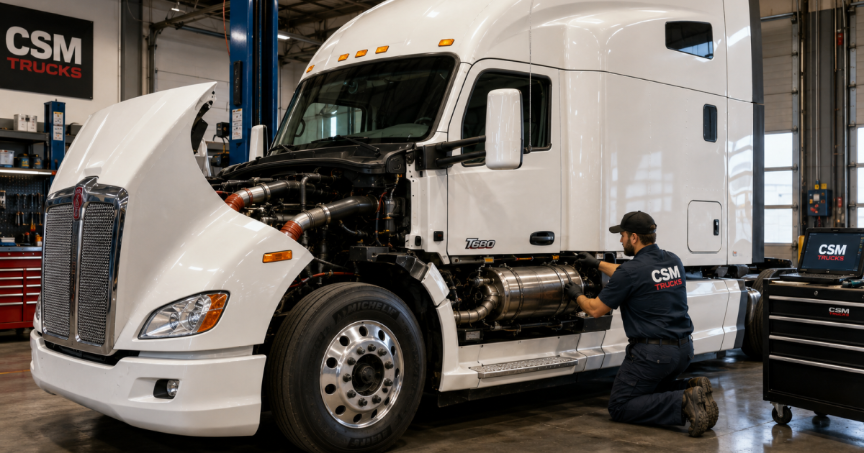
DPF Cleaning on a Kenworth Truck: Key Facts
A diesel particulate filter goes unnoticed until it restricts flow, and on a Kenworth T680 that point marks the difference between a completed route and a forced stop. Federal standards have required a filter on every on-highway diesel since the 2007 model year under EPA emissions rules, so Kenworth DPF cleaning is a routine part of ownership, not an optional extra.
At CSM Companies, we keep T680s earning by catching aftertreatment issues early and servicing the PACCAR MX system the way it was engineered to be maintained. That work is handled by PACCAR-trained technicians at a three-time Kenworth Dealer of the Year.
• What it is: cleaning removes accumulated ash and soot from the diesel particulate filter to restore exhaust flow.
• Why it matters: a clogged filter triggers frequent regens, power derates, and lost uptime.
• Interval: typically every 150,000 to 200,000 miles, or sooner if regens grow frequent.
• Regen is not cleaning: regeneration burns off soot, but only physical cleaning removes ash.
• Cleaning vs replacement: cleaning restores an intact filter; replacement is for cracked or melted substrates.
Why Kenworth T680 DPF Maintenance Matters
On a Kenworth T680, the filter sits in the exhaust stream and traps the fine soot a diesel produces. Left unserviced, it restricts flow, forces the engine into repeated regenerations and can force the truck into a derate that caps road speed.
Staying ahead of this maintenance protects fuel economy, emissions compliance and, above all, uptime. A planned service costs far less than a roadside failure and recovery.
“Most DPF problems we see began as ignored regens,” says a CSM Companies service technician. “Serviced on schedule, the filter lasts. Left until the engine derates, it becomes a roadside tow and a larger repair.”
How the PACCAR MX Aftertreatment System Uses the DPF
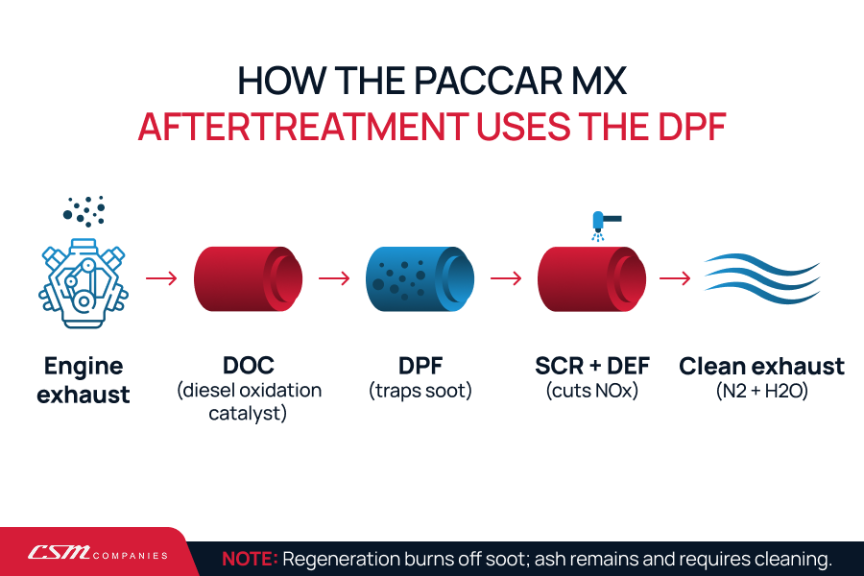
The PACCAR MX-13 and MX-11 engines route exhaust through a sequence of components that clean it before it leaves the stack. Understanding how the system works matters because it helps owners read the warning signs early and avoid both unplanned downtime and repairs the truck never actually needed.
DOC, DPF and SCR
Exhaust first passes through the diesel oxidation catalyst (DOC), then the diesel particulate filter (DPF), which traps soot, and finally selective catalytic reduction (SCR), where diesel exhaust fluid converts nitrogen oxides into nitrogen and water vapor.
The DOC raises exhaust temperature and oxidizes hydrocarbons and carbon monoxide, which enables both passive and active regeneration further down the system.
Regeneration: Passive, Active and Parked
The system burns off trapped soot through regeneration. Passive regens occur at highway temperatures, active regens add fuel to raise exhaust heat, and a parked regen runs while the truck is stationary when soot climbs too high.
Regeneration addresses soot, but it cannot remove the ash left behind by engine oil. That ash is what eventually requires a physical PACCAR MX-13 DPF cleaning.
Signs Your Kenworth T680 May Need DPF Cleaning
A Kenworth T680 typically signals trouble before the filter fails and catching these signs early is the difference between a scheduled cleaning and an on-road derate. Watch for:
• Frequent or incomplete regenerations, or repeated parked-regen prompts.
• A DPF or check-engine lamp on the dash.
• Noticeable power derate or a capped road speed.
• A drop in fuel economy over recent tanks.
• High exhaust back pressure flagged during service.
Schedule a DPF inspection for your Kenworth at CSM Companies.
When PACCAR MX DPF Cleaning May Be Needed
Cleaning is scheduled by mileage or by symptom, whichever comes first. Because the right interval varies with duty cycle, application and operating environment, we evaluate each truck individually rather than applying a single number.
Recommended Service Intervals
Most operators clean the filter every 150,000 to 200,000 miles, following the PACCAR service schedule for the engine and duty cycle. Heavy idling, short routes and frequent stops shorten that interval. These figures are starting points, not a fixed rule; we tailor the interval to how your truck actually runs.
When Symptoms Come First
If regens grow frequent, a warning lamp appears or the engine derates before that mileage, the filter needs attention sooner. A back-pressure check confirms whether cleaning is due.
Tracking regeneration frequency over time is the simplest early indicator. A truck that requires a parked regen every day or two is approaching the point where cleaning is due.
Speak with a PACCAR-trained technician about your service interval.
DPF Cleaning vs. DPF Replacement for Kenworth Trucks
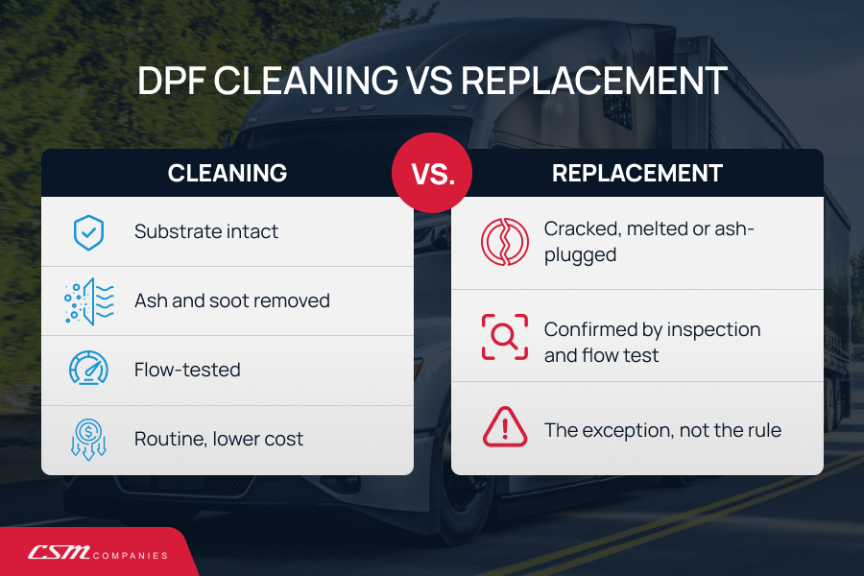
For most Kenworth trucks, cleaning restores the filter and replacement is the exception.
Professional cleaning removes ash and soot from a filter whose ceramic substrate is intact, returning it close to original flow. It is the routine, lower-cost path and the appropriate choice for the large majority of filters.
Replacement becomes necessary when the substrate is cracked or melted, often from over-fueling or repeated failed regens, or when ash has plugged the filter beyond what cleaning can recover. A technician confirms which path applies through inspection and flow testing.
Deleting or bypassing the filter is not an option: federal law prohibits tampering with emissions equipment under EPA policy, and it exposes the operator to significant penalties.
A thorough cleaning is more than a quick pass with compressed air. A qualified shop bakes the filter to burn off residual soot, follows with a pneumatic air-pulse cycle to clear the ash, then runs a flow test to confirm the filter meets specification.
That is why the facility matters as much as the schedule. Look for PACCAR-trained technicians, dedicated DPF cleaning equipment, flow testing and genuine replacement filters, so the work holds up and helps protect your warranty.
FAQs About Kenworth DPF Cleaning
The questions we hear most from T680 and PACCAR MX owners:
It is the removal of accumulated ash and soot from the diesel particulate filter to restore exhaust flow and normal operation.
Typically every 150,000 to 200,000 miles, or sooner with heavy idling, short routes or frequent regens.
No. A regeneration burns off soot; cleaning physically removes the ash that a regen cannot.
Frequent regens, a DPF or check-engine lamp, a power derate, or a noticeable drop in fuel economy.
Exhaust flows through the DOC, then the DPF, then SCR with diesel exhaust fluid to cut soot and nitrogen oxides.
Yes. High back pressure from a clogged filter can force the engine into a reduced-power derate to protect it.
Cleaning restores an intact filter; replacement is for cracked, melted or ash-plugged substrates, confirmed by inspection.
Professional thermal and pneumatic cleaning with flow testing usually takes several hours or up to a day, depending on the facility’s workload.
No. Federal law prohibits tampering with or removing emission equipment, including the diesel particulate filter.
CSM Companies performs Kenworth and PACCAR MX DPF service with OEM-trained technicians across its network of more than 30 locations.
Kenworth DPF cleaning is routine maintenance rather than a crisis, provided you stay ahead of it. Monitor regeneration frequency and warning lamps, follow the PACCAR service interval, and clean the filter before ash forces the issue. CSM Companies services the PACCAR MX aftertreatment with PACCAR-trained technicians and genuine parts across more than 30 locations, keeping your T680 compliant and in service. Provide your mileage and symptoms, and we will schedule the work at a location near you.
Schedule Kenworth DPF cleaning with CSM Companies.