
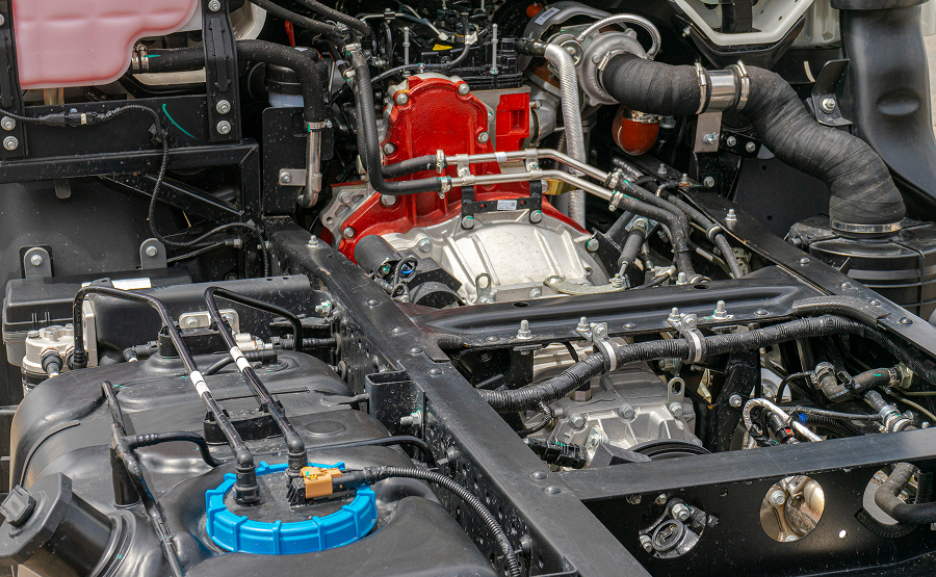
Semi-Truck Engines: Key Facts
A loaded tractor-trailer grosses around 80,000 pounds, and moving that weight is the engine’s job alone. A semi-truck engine is built for sustained pulling power rather than speed, and the way it is sized and spec’d decides whether a truck runs profitably or spends its days waiting on a service bay.
Spec’ing and maintaining these engines has been the core of what we do at CSM Companies for more than 45 years, so the summary below reflects how we set trucks up for the work they actually run.
• Configuration: a heavy-duty four-stroke diesel, almost always a turbocharged inline-six.
• Displacement: typically 11 to 16 liters, with 13L and 15L the most common.
• Power: roughly 350 to 600 horsepower.
• Torque: roughly 1,250 to 2,050 lb-ft, the figure that actually moves freight.
• Emissions: every on-highway diesel built since 2010 runs EGR, a DPF and SCR with DEF, as EPA rules require.
Common Semi-Truck Engine Types
Nearly every semi-truck on the road runs a diesel, and the ones we sell and service come from a short list of reliable manufacturers. A few alternative powertrains are gaining ground in specific applications, but the diesel families are where spec’ing a truck to its route begins.
Diesel Engines: Still the Standard
Diesel powers well over 90 percent of Class 8 trucks, and the reasons are practical: it is energy-dense, produces strong torque at low engine speeds and holds up over high mileage. As a Kenworth dealer, we work most often with PACCAR MX-13 and MX-11 power in Kenworth trucks such as the T680 Next Gen and W990, and we also sell and support the Cummins X15 for customers who prefer it. Detroit’s DD15, Volvo’s D13 and Mack’s MP8 fill out the field, all built on the same architecture: an inline-six with a turbocharger and full aftertreatment.
One pattern our technicians see repeatedly is that the long block rarely limits one of these engines. The aftertreatment hardware and its sensors are what most often take a truck out of service, which is why we treat that system as central to uptime rather than a compliance afterthought.
Natural Gas Engines
A number of regional and municipal fleets run compressed or liquefied natural gas, using engines such as the Cummins X15N. Natural gas lowers emissions and can reduce fuel cost, but shorter range and a thin fueling network keep it practical mainly for trucks that return to a home yard each day.
For the over-the-road lanes most of our customers run, it remains a specialized choice.
Electric and Hydrogen Powertrains
Battery-electric tractors such as the Freightliner eCascadia and Volvo VNR Electric already handle regional freight, and hydrogen fuel-cell trucks are running in pilot fleets. On the diesel side, Kenworth’s SuperTruck 2 program is advancing fuel economy and aerodynamics well beyond current production trucks.
We follow all of it, and our advice to customers is candid: for long-haul work, diesel remains the right answer today, while battery-electric is only beginning to make financial sense on drayage and short depot-charged routes.
Engine Displacement and Size Explained
Engine size is a question of displacement, the total volume the cylinders sweep, measured in liters. A 15L produces more torque but adds weight and burns more fuel, so we spec it for heavy loads and mountainous lanes where the extra pulling power pays for itself. A 13L gives back payload capacity and still makes ample torque for regional work, which is why some of the regional trucks we build are set up as a downsped 13L with tall rear gears to protect fuel economy. Smaller 11L engines suit lighter vocational trucks.
“The most expensive spec mistake we see is buying more engine than the lane needs,” says a CSM Companies service manager. “The 15L earns its keep in the mountains. On flat regional work, the downsped 13L is what pays the bills.”
Horsepower vs Torque: What Matters Most?
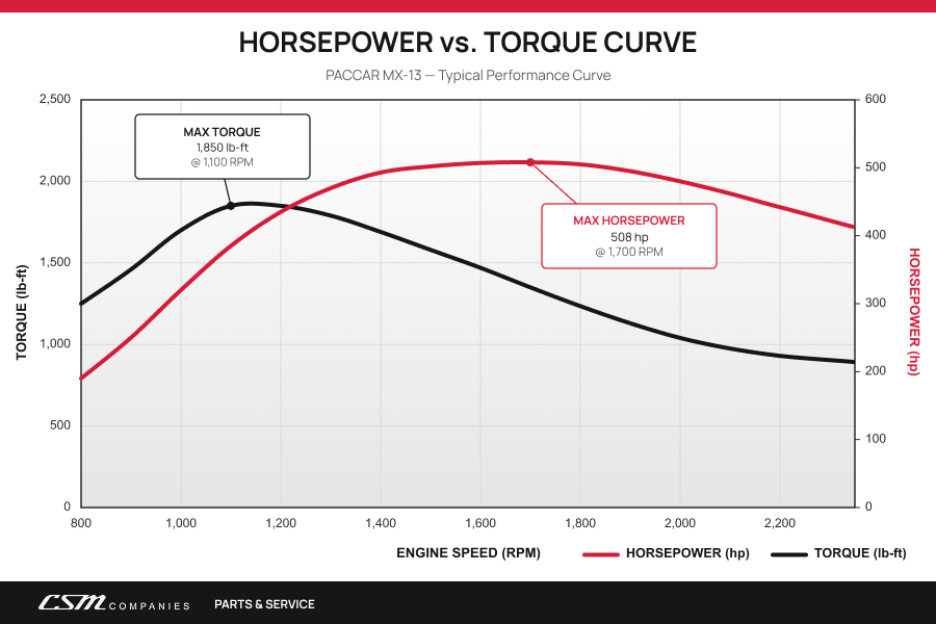
Horsepower and torque describe different things, and for a working truck, torque is the one that counts. Torque is the rotational force that gets 80,000 pounds rolling and holds speed against a grade, and a diesel delivers it low in the rev range, usually between 1,000 and 1,200 rpm, exactly where the engine spends its time under load.
Horsepower, which is torque multiplied by engine speed, governs how well a truck holds a higher cruise.
AT CSM dealerships, we spec the engine to the client’s needs – adjusting torque and horsepower to their loads and on-highway usage. A common Class 8 pairing is around 500 horsepower and 1,850 lb-ft, and it is the torque figure we build the driveline around.
Factors That Impact Semi Truck Performance
Two trucks with identical engines can perform very differently, because the spec sheet describes only part of the picture. These are the variables that decide real-world performance, and the ones we weigh when we set a truck up:
• Load weight: a higher gross combination weight demands more torque to hold speed.
• Terrain: long grades expose an underpowered driveline quickly.
• Axle ratio and transmission: gearing must match your speed and load, and a modern automated manual protects fuel economy.
• Aerodynamics: fairings and trailer skirts return more fuel savings than a horsepower increase.
• Aftertreatment health: the DPF and SCR system rank among the top causes of unplanned downtime, so staying ahead of regens and sensor faults directly protects uptime.
• Driver technique: heavy throttle and extended idling burn fuel and accelerate wear.
Choosing the Right Engine for Your Application
There is no single best semi-truck engine, only the right engine for the work, and this is where the relationship with a dealer matters more than the transaction. Heavy mountain loads call for a 15L with high torque; flatter regional lanes run efficiently on a downsped 13L; vocational work needs strong low-end torque and a rugged driveline.
Engine brand carries more weight in that decision than it once did, because several proprietary engines went through a period of reliability problems, and that history still shapes how buyers think about resale and downtime. We address that concern directly. Kenworth has held some of the strongest residual value in the market for years, on the strength of build quality and driver demand, and for a customer who wants to set the proprietary-engine question aside, we can spec a Cummins X15 instead.
We are not the lowest-price dealer and do not position ourselves that way. We consistently earn business through reliable partnerships, service after the sale, and deal structure, including a willingness to take large used-truck trade packages that other dealers turn away from. Whatever the badge on the valve cover, uptime comes down to the same things: parts on our shelves, technicians who know the engine and service that keeps a small fault from becoming a breakdown.
Future Trends in Semi-Truck Engine Technology

Diesel will anchor freight for years, but the technology is moving quickly, and we keep track of it so our spec advice stays current. These are the developments worth watching:
• Tighter emissions: EPA’s 2027 rules require another substantial NOx reduction, which means more capable aftertreatment.
• Battery-electric: the eCascadia and Volvo VNR Electric continue to scale on regional and drayage routes.
• Efficiency demonstrators: Kenworth’s SuperTruck 2 previews the next round of gains in fuel economy and aerodynamics.
• Hydrogen fuel cells: longer-range, zero-emission pilots aimed at lanes batteries cannot yet cover.
• Renewable diesel and downspeeding: cleaner fuel and smarter gearing continue to improve efficiency.
FAQs About Semi-Truck Engines
The questions we hear most when drivers and fleets are sizing up a semi-truck engine:
Almost always a heavy-duty diesel inline-six, such as the Cummins X15, PACCAR MX-13, Detroit DD15 or Volvo D13. A few fleets run natural gas or electric, but diesel still dominates.
Most displace 11 to 16 liters, with 13L and 15L the most common. The 15L is the long-haul standard; a 13L covers regional work and saves weight.
Nearly all are inline-sixes. The layout is durable, smooth and straightforward to service, which is why every major manufacturer uses it on Class 8 trucks.
Usually 350 to 600 horsepower, with long-haul trucks around 450 to 500, paired with 1,250 to 2,050 lb-ft of torque.
For a working truck, torque. It gets a heavy load moving and holds speed on a grade, while horsepower sustains a higher cruise. Spec both but lead with torque.
A well-maintained heavy-duty diesel commonly runs 750,000 to over 1,000,000 miles before a major overhaul. Clean oil, clean fuel, and a healthy aftertreatment system make the difference.
There is no single answer; durability depends on maintenance, application, and how a truck is driven. The Cummins X15, PACCAR MX-13, Detroit DD15 and Volvo D13 all have strong records, and in our shops the engines that last are the ones that are serviced on schedule.
Yes, well over 90 percent of the Class 8 fleet. Diesel’s energy density, low-end torque and long life are hard to match, though other powertrains are growing on regional routes.
A new heavy-duty diesel runs in the tens of thousands of dollars, and an in-frame rebuild often lands in the low-to-mid five figures. Ask us for a quote on your specific engine.
Not soon for long-haul. Electric and hydrogen fit regional and depot routes, but until range and charging catch up, diesel will move most long-distance freight.
Spec’ing a truck well is where an experienced dealer group earns its place. At CSM Companies we spec trucks for how they will be run, from PACCAR MX-13 power through the whole driveline, and back them with parts and factory-trained technicians at every location, from Wisconsin Kenworth to French Ellison Truck Center. We structure the deal, trade package included, to get a customer into the right truck. New, used, or keeping a current truck healthy, the objective does not change: keeping you earning.