
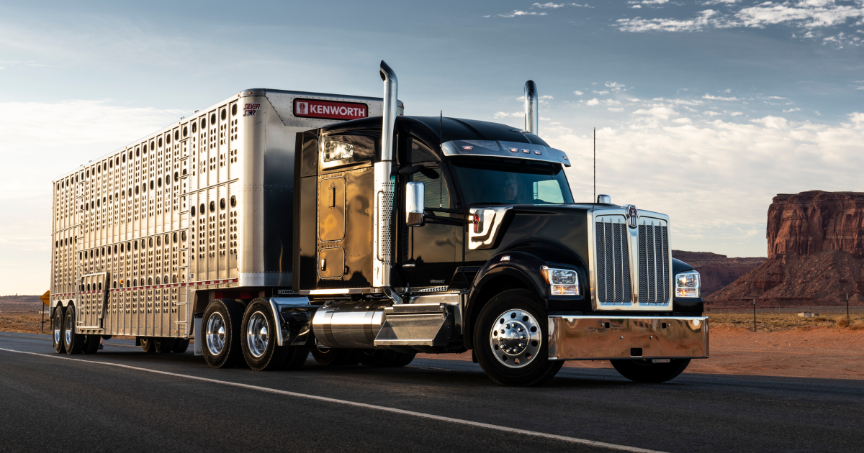
Heavy Duty Trucks: Key Facts
Trucks move about 65 percent of the nation’s freight by weight, according to the U.S. Bureau of Transportation Statistics Freight Facts and Figures, and the heaviest of them move the loads that keep supply chains running. So, what is a heavy duty truck? It is a commercial vehicle rated above 26,000 pounds, engineered to haul the largest legal loads over the longest routes.
Knowing where a truck falls in the range is not academic. The class you choose sets payload, licensing, running cost, and how long the truck stays productive. Which is why we start every heavy duty conversation here.
At CSM Companies, we help operations spec heavy duty trucks to the work they carry, so the truck delivers the uptime and cost-per-mile the business is counting on. That guidance is backed by more than 45 years in the industry, and three Kenworth Dealer of the Year awards.
• GVWR: a gross vehicle weight rating above 26,000 pounds, covering federal Classes 7 and 8.
• Class 8: the largest trucks, rated above 33,000 pounds, including most highway tractors.
• Licensing: a commercial driver’s license is required to operate one.
• Common work: long-haul freight, construction, refuse and heavy vocational applications.
• Powertrain: high-torque diesel engines such as the PACCAR MX-13, matched to heavy axles and multi-speed transmissions.
How Heavy Duty Truck Classes Work
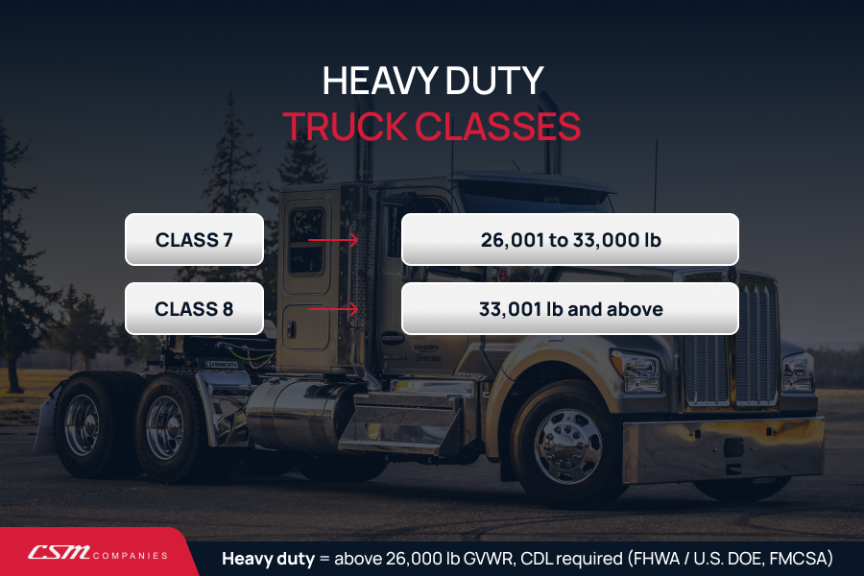
Truck classes run from 1 to 8, based on gross vehicle weight rating (GVWR), the maximum a truck is certified to weigh fully loaded. Heavy duty occupies the top of that scale, Classes 7 and 8, which the Federal Highway Administration and the U.S. Department of Energy define as everything above 26,000 pounds. The class drives payload capacity, operating cost, and resale, so choosing the wrong one can cap the loads you carry or add costs you never use.
• Class 7: 26,001 to 33,000 pounds, often with three or more axles.
• Class 8: 33,001 pounds and above, including sleeper and day-cab tractors.
What GVWR and GCWR Mean
GVWR rates a single truck fully loaded. Gross combination weight rating (GCWR) rates a tractor plus its loaded trailer together, which is the number that matters most for a Class 8 highway tractor.
GVWR and GCWR are among the first numbers we check when helping a customer spec a truck. They set what you can legally haul, which license the truck requires, and how much room you leave for growth. Confirm both before finalizing a specification.
Why a CDL Is Required
A commercial driver’s license is required for any truck rated above 26,000 pounds, so every heavy duty truck requires one, per the Federal Motor Carrier Safety Administration. A single vehicle requires a Class B, while a tractor towing a heavy trailer requires a Class A.
Class 7 vs. Class 8 Trucks
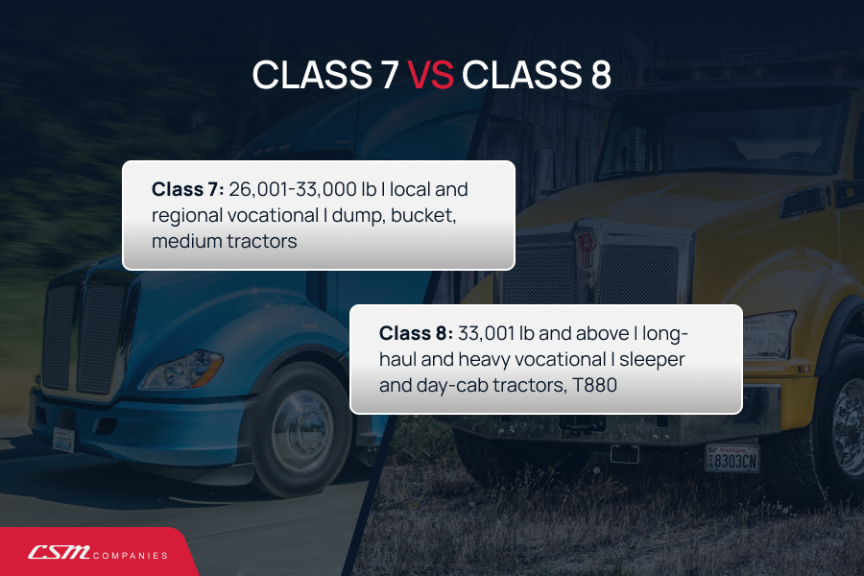
The distinction between Class 7 and Class 8 is where vocational trucks give way to the largest highway tractors. Class 7 trucks, at 26,001 to 33,000 pounds, handle heavier local and regional work, while Class 8 trucks, at 33,001 pounds and above, pull the tractor-trailers that move freight across the country.
Most sleeper tractors, such as the Kenworth T680 and W990, are Class 8, as are heavy vocational trucks such as the Kenworth T880 configured for dump, mixer and refuse bodies.
The right class depends less on the spec sheet than on your operations: the routes you run, the payloads you carry, where you expect your business to grow. That is the conversation we work through with customers before recommending Class 7 or Class 8 trucks.
Common Types of Heavy Duty Trucks
Selecting a heavy duty truck begins with understanding the operation it serves, then matching the body and configuration to that work. The most common configurations include:
• Sleeper and day-cab tractors for long-haul and regional freight.
• Dump trucks and concrete mixers for construction and aggregate.
• Refuse trucks for municipal and commercial waste routes.
• Tanker trucks for fuel, chemicals and bulk liquids.
• Heavy haul and specialized vocational trucks for oversized loads.
Let our team help you spec the right heavy duty truck for your operation.
What Are Heavy Duty Trucks Used For
The applications for a heavy duty truck come down to weight and distance. When a load is too large or a route too long for a medium duty truck, the work moves to Class 7 and Class 8.
• Long-haul and regional freight, where tractors pull loaded trailers near the 80,000-pound legal limit.
• Construction and aggregate, where dump trucks and mixers move heavy material.
• Waste and municipal service, where refuse trucks operate demanding daily routes.
• Energy and bulk transport, where tankers carry fuel and liquids.
“At the heavy end, the truck is a production asset,” says a CSM Companies fleet specialist. “Every hour it sits represents lost revenue. That is why we treat specification, service, and parts planning as one system: each one protects uptime, and together they keep the truck earning.”
Speak with the CSM Companies spec team about your routes.
Heavy Duty Trucks vs. Medium Duty Trucks
Medium duty trucks fill Classes 3 through 6, from 10,001 to 26,000 pounds, and handle regional and local work without a CDL. Heavy duty begins where medium duty ends, at 26,001 pounds, and carries the heaviest loads over the longest routes.
Select medium duty when loads stay under 26,000 pounds. Move up to heavy duty when payload, towing or over-the-road mileage requires greater capability, and compare both in our new and used inventory.
Key Features of Heavy Duty Commercial Trucks
Several systems distinguish heavy duty commercial trucks from lighter classes. We weigh each one when spec’ing a truck because the engine, drivetrain, and aftertreatment choices decide payload, fuel cost, reliability, and total cost of ownership over the life of the truck.
Engines, Transmissions and Axles
These trucks run high-torque diesel engines, such as the 12.9-liter PACCAR MX-13 rated up to approximately 510 horsepower and 1,850 lb-ft of torque, or the Cummins X15. That output is delivered through a heavy-duty automated or manual transmission, and high-capacity drive axles rated for the load.
Powertrain is a specification decision, not a product one. We match the engine, transmission and axle ratio to a customer’s typical loads and grades, so the truck holds speed where it works and protects fuel economy instead of carrying capability the routes never use.
Aftertreatment and Emissions Systems
Every on-highway diesel built since 2010 carries an aftertreatment system: a diesel oxidation catalyst, a diesel particulate filter (DPF) and selective catalytic reduction with diesel exhaust fluid. These systems keep the truck compliant with EPA emissions rules and require routine service to protect uptime.
Heavy Duty Truck Maintenance and Service Considerations
A truck earns only when it operates, so a service plan belongs in the purchase decision. Uptime is a discipline, engineered through preventative maintenance, parts availability and technicians trained on the platform.
Preventative Maintenance and DOT Compliance
Maintenance planning is part of protecting a truck’s long-term performance, not just fixing it when something fails.
Scheduled maintenance identifies wear before it stops a truck and maintains compliance with DOT and FMCSA inspection requirements. Our OEM-trained technicians perform full powertrain and chassis work across our service centers, and as a Kenworth PremierCare Gold dealer we provide mobile and extended-hours options.
Heavy Duty Truck Repair and Parts
Parts availability is a critical component of minimizing downtime, not a convenience.
When a truck is out of service, prompt access to the correct parts decides whether it returns to work the same day or waits while a component sits on back order.
We support repairs with a deep parts inventory and the nationwide PACCAR parts system, so common components remain in stock.
Order or inquire about heavy duty truck parts through our parts team to keep planned service brief and downtime shorter.
Schedule service and repair for your truck with CSM Companies.
FAQs About Heavy Duty Trucks
The questions we receive most often from owners and fleets evaluating a heavy duty truck:
Any commercial truck rated above 26,000 pounds GVWR, which covers federal Classes 7 and 8.
Class 7 trucks are rated 26,001 to 33,000 pounds; Class 8 trucks are rated 33,001 pounds and above, the heaviest category.
Yes. Highway tractors that pull semi-trailers are Class 8, the largest heavy duty class.
Yes. A single truck requires a Class B CDL, and a tractor towing a heavy trailer requires a Class A.
Class 8, rated above 33,001 pounds, which includes long-haul tractors and the largest vocational trucks.
High-torque diesels such as the PACCAR MX-13 and Cummins X15, engineered for pulling power and long service life.
A loaded Class 8 tractor-trailer typically operates up to the 80,000-pound federal gross weight limit without special permits.
Well maintained, they commonly reach 750,000 to more than 1,000,000 miles before a major overhaul. Service history matters more than age.
Medium duty tops out at 26,000 pounds for regional work; heavy duty begins at 26,001 pounds for the heaviest loads and longest routes.
CSM Companies provides heavy duty truck repair and parts across its service network of more than 30 locations.
Determining what a heavy duty truck is comes down to weight, class and the work ahead, from a Class 7 vocational truck to a Class 8 highway tractor. CSM Companies sells, services and supplies parts for these trucks from Kenworth, Mack, Hino, Autocar and Capacity across more than 30 locations, and we spec each one to protect the uptime your operation depends on. Provide the details of your operation, and we will help you match the right truck in our new and used inventory.
Browse our new and used heavy-duty truck inventory.