
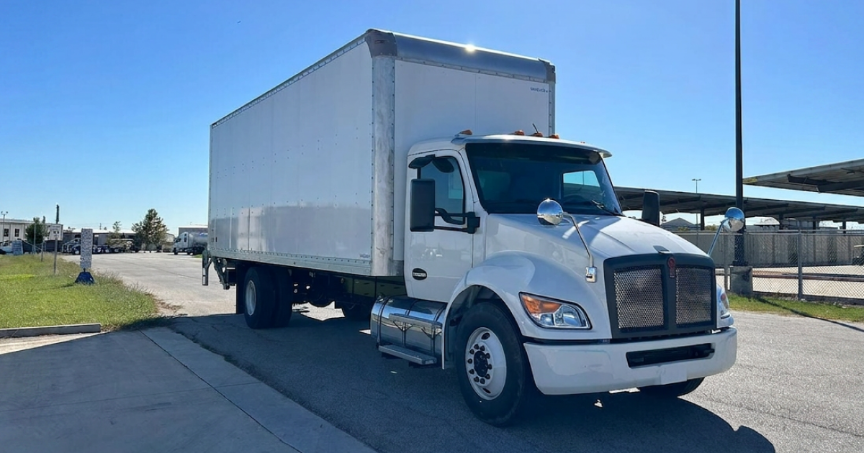
Medium Duty Trucks: Key Facts
Trucks carry about 65 percent of the nation’s freight by weight, according to the U.S. Bureau of Transportation Statistics Freight Facts and Figures, and much of that freight moves on trucks smaller than a long-haul tractor. So what is a medium duty truck? It is a commercial vehicle built for the middle of the weight range, combining substantial payload capacity with the maneuverability that city streets and regional routes require.
At CSM Companies, we start with the work a truck must do, then spec the class, body, and drivetrain to match it, so you only buy the capability your operation needs. That guidance is backed by more than 45 years in the industry and three Kenworth Dealer of the Year awards.
• GVWR: a gross vehicle weight rating of 10,001 to 26,000 pounds, which covers federal Classes 3 through 6.
• Position: heavier than a light-duty pickup or van, lighter than a Class 8 tractor.
• Common bodies: box, refrigerated, dump, stake, bucket, and tow trucks.
• Licensing: a single truck rated at 26,000 pounds or less requires no commercial driver’s license for weight alone.
• Right fit: determined by payload, body style, route, and total cost of ownership rather than horsepower.
Class 3, Class 4, Class 5, and Class 6 Trucks Explained
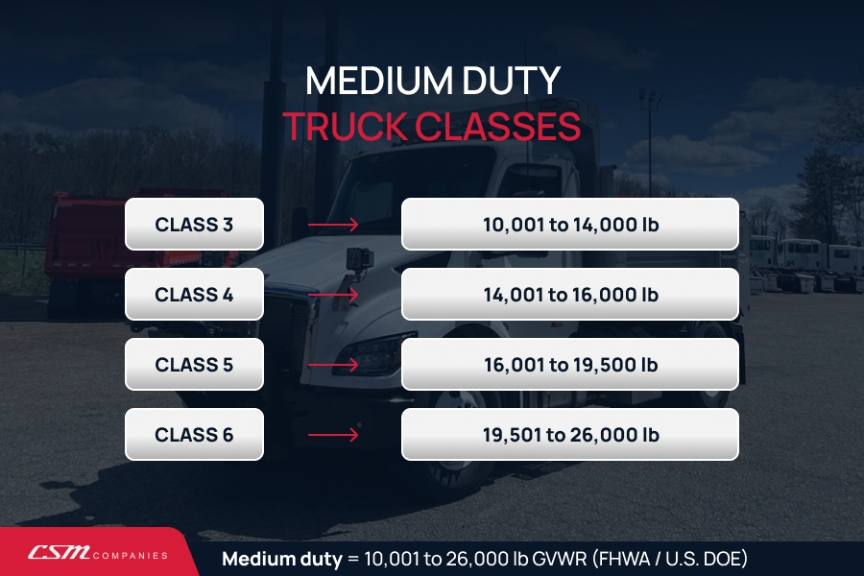
The Federal Highway Administration and the U.S. Department of Energy group that 10,001 to 26,000-pound band into Classes 3, 4, 5 and 6. Together they account for most of the commercial trucks engaged in local delivery and jobsite work.
• Class 3 (10,001 to 14,000 pounds): heavier pickups, walk-in vans, and city delivery trucks.
• Class 4 (14,001 to 16,000 pounds): box trucks and landscape trucks.
• Class 5 (16,001 to 19,500 pounds): larger box trucks, bucket and utility trucks.
• Class 6 (19,501 to 26,000 pounds): beverage trucks and single-axle dump trucks.
What GVWR Means for Your Payload
Gross vehicle weight rating states the maximum weight the manufacturer certifies for a truck fully loaded, including the chassis, body, fuel, driver and cargo. Because GVWR sets up the class, it indicates working capacity far more accurately than engine size.
Review the rating first, then subtract the combined weight of the truck and body to determine the cargo you can legally haul. Matching GVWR to the load early protects productivity and total operating cost across the truck’s service life. Too little rating caps payload, while too much adds weight and fuel expense you never recover.
Why the 26,000-Pound Threshold Matters
We raise licensing early in the spec process because it decides who can drive the truck, which affects hiring, scheduling, and cost.
A single vehicle rated at 26,000 pounds or less does not require a commercial driver’s license for weight alone, per the Federal Motor Carrier Safety Administration, so keeping a truck under that line can widen your pool of eligible drivers. Because Classes 3 through 6 fall below that threshold, many operations can staff these trucks without CDL holders.
Towing heavy trailers, transporting hazardous materials or carrying passengers can still require a CDL or an endorsement, so confirm the requirements for your route before finalizing a specification.
Common Types of Medium Duty Trucks
The right type is determined by the body mounted on the chassis, because a single Class 5 frame can support very different equipment. Selecting the body for the application typically settles the class as well.
Box and straight trucks handle freight, moving and last-mile delivery, and frequently use Kenworth medium duty models such as the T270 and T280 available in our Kenworth inventory.
• Refrigerated (reefer) trucks for food, beverage and pharmaceutical distribution.
• Dump trucks for construction, aggregate and landscaping.
• Stake-bed and flatbed trucks for building materials and equipment.
• Bucket and utility trucks for electrical, telecom and municipal crews.
• Tow and recovery trucks for roadside and fleet service work.
Find the right medium duty truck for your operation at CSM Companies.
What Are Medium Duty Trucks Used For
The applications for a medium duty truck follow the route more than the load. These trucks perform best on regional and local work, returning to a yard most nights and covering predictable mileage.
Matching the truck to its actual application is what protects uptime and cost per mile. A truck sized and bodied for the route runs more efficiently, needs less unplanned service, and returns more productive hours.
Operations select medium duty when a task exceeds a pickup but does not require a Class 8 tractor. Typical applications include:
• Local and regional delivery, including last-mile freight into dense neighborhoods.
• Food and beverage distribution, where refrigerated bodies protect the product.
• Construction and landscaping, where dump and stake bodies move material to the site.
• Utility, telecom, and municipal service, where bucket and service bodies carry crews and tools.
“The correct approach is to match the truck to the route and the payload before the horsepower,” says a CSM Companies fleet specialist. “A truck specified correctly for its work delivers more productive hours and fewer days out of service.”
Speak with the CSM Companies spec team about your routes.
Medium Duty Trucks vs. Heavy Duty Trucks
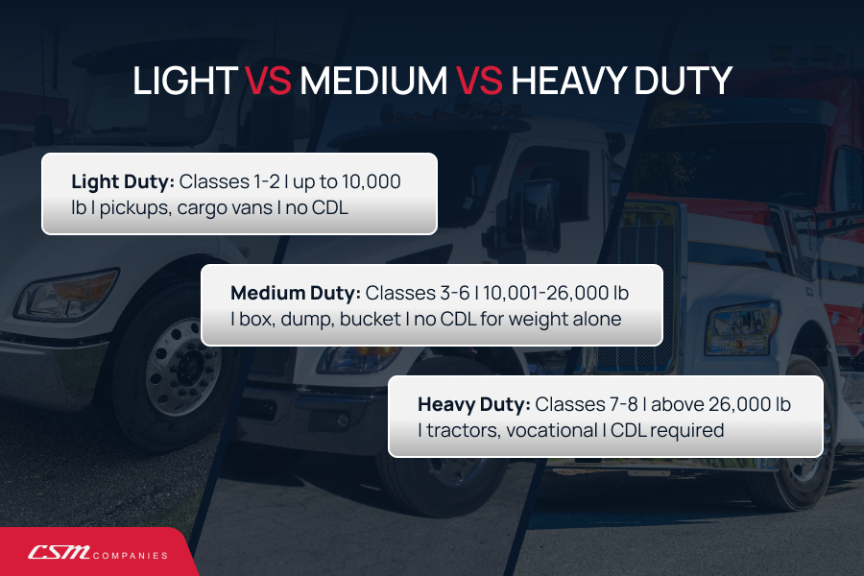
Heavy duty trucks occupy Classes 7 and 8, beginning at 26,001 pounds and extending well beyond 33,000 pounds for the tractors that pull long-haul trailers. They carry more, operate over longer distances and require a CDL.
Select heavy duty when payload, towing or over-the-road mileage exceeds the capability of a Class 6 truck. That capability carries a higher purchase price, greater fuel consumption and more involved maintenance.
Select medium duty when the work remains regional and loads stay within 26,000 pounds. Many fleets operate both, and our new and used inventory spans medium and heavy duty so each truck can be sized to its role.
Medium Duty Trucks vs. Light Duty Trucks
Light duty trucks fill Classes 1 and 2, up to 10,000 pounds, and include the pickups and cargo vans many businesses begin with. They handle light loads and light-duty cycles capably, but they are not built for sustained commercial duty cycles.
Move up to medium duty when payload, cargo volume or duty cycle begins to exceed a light duty platform. A Class 4 or Class 5 truck carries more, withstands constant stop-and-go operation and often reduces cost per mile once the workload justifies it.
When pickups routinely operate at their limit, the payload and durability of a medium duty truck generally justify the investment. Our team can weigh the figures against your routes, or you can review options in our used truck inventory.
Medium Duty Truck Maintenance and Service Considerations
A truck creates value when it operates, not when it sits, so maintenance planning belongs in the purchase decision. Uptime is a discipline, engineered through preventative service, parts availability and technicians trained on the platform.
Preventative Maintenance and DOT Compliance
Scheduled preventative maintenance identifies wear before it becomes a failure and maintains compliance with DOT and FMCSA inspection requirements. Our OEM-trained technicians perform full powertrain and chassis service across our service centers.
As a Kenworth PremierCare Gold dealer, we respond quickly when it matters most. Scheduling service around your routes allows a planned stop to replace a costly roadside repair.
Medium Duty Truck Parts and Availability
Prompt availability is not an inconvenience; it’s one of the biggest levers on downtime and on the revue a truck earns. Prompt access to the correct parts determines whether a repair concludes the same day or stalls while a component is on back order.
We maintain a deep parts inventory supported by the nationwide PACCAR parts system, so common components remain in stock.
Order or inquire about medium duty truck parts through our parts team to keep planned service brief and unplanned downtime shorter.
Schedule truck service and parts support with CSM Companies.
FAQs About Medium Duty Trucks
The questions we receive most often from owner-operators and fleets evaluating a medium duty truck:
Not quite. Class 6 is one of four medium duty classes; medium duty spans Classes 3 through 6, from 10,001 to 26,000 pounds.
For weight alone, no. A single vehicle rated at 26,000 pounds or less falls below the federal CDL threshold, though hazardous materials, passengers or heavy towing can still require one.
It spans 10,001 to 26,000 pounds gross vehicle weight rating.
Most are. Common delivery and moving box trucks fall within Classes 4 through 6, placing them in the medium duty range.
Medium duty tops out at 26,000 pounds for regional work; heavy duty trucks begin at 26,001 pounds and are built for higher payloads and long-haul routes.
Class 5 trucks, rated 16,001 to 19,500 pounds, commonly serve as larger box trucks, bucket trucks and utility trucks for delivery and service work.
Yes. Their payload and maneuverability make them well suited to local and regional delivery, including last-mile routes.
With consistent preventative maintenance, they commonly reach several hundred thousand miles. Service history matters more than age.
Major medium duty manufacturers include Kenworth and Hino, among others. CSM Companies sells and services Kenworth, Mack, Hino, Autocar and Capacity.
CSM Companies stocks them across its network, supported by the nationwide PACCAR parts system for prompt availability.
Determining what a medium duty truck is comes down to matching class, body and route to the work at hand, then weighing total cost of ownership ahead of purchase price. CSM Companies sells and services these trucks from Kenworth, Mack, Hino, Autocar and Capacity across more than 30 locations, and we spec each one to protect the uptime your business depends on. Provide the details of your operation, and we will help you match the right truck to the work in our new and used inventory.
Browse our new and used medium duty truck inventory.