
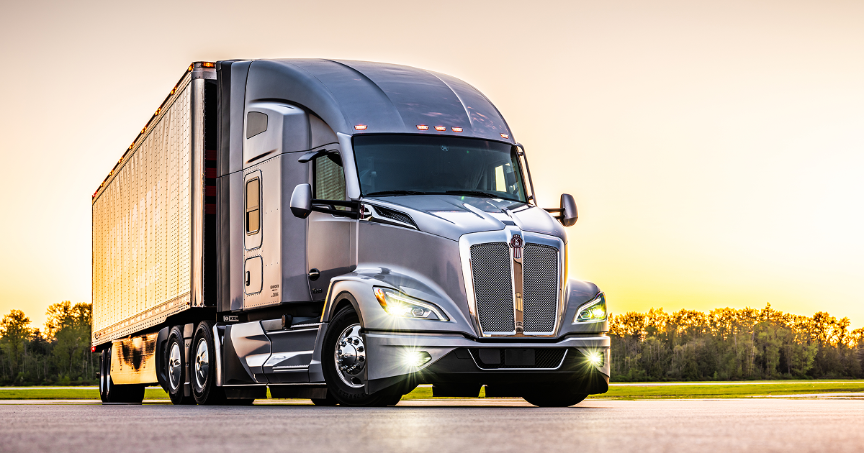
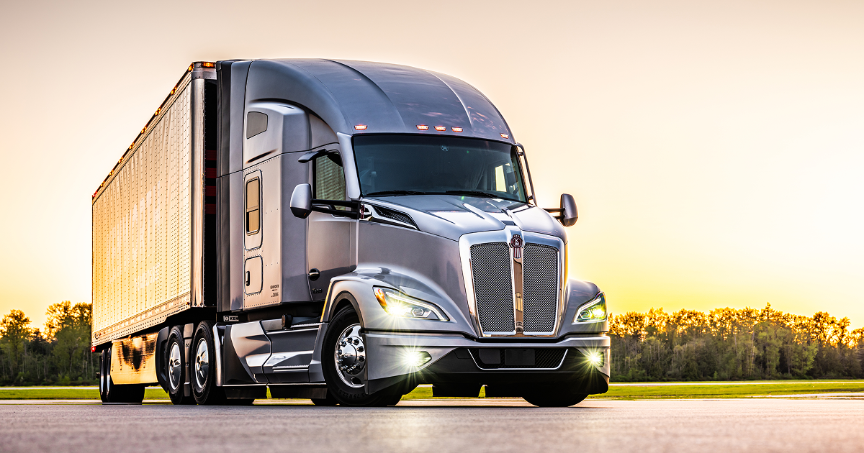
Semi Truck: Key Facts
Trucks carry about 65 percent of the nation’s freight by weight, according to the U.S. Bureau of Transportation Statistics, and the semi is the vehicle doing most of that heavy lifting. Whether you are buying your first rig or building a fleet, knowing the terms and the tradeoffs helps you spec and maintain the right truck for the work.
At CSM Companies, we help owners and fleets choose, service and keep these trucks running, with new and used inventory, parts and OEM-trained technicians. That support is backed by a network across six states and a three-time Kenworth Dealer of the Year.
• What it is: a tractor with an engine and cab that connects to a semi-trailer by a fifth wheel, while the trailer carries no front axle of its own.
• Also called: a semi, tractor-trailer, big rig or 18-wheeler, all names for the same tractor-and-trailer combination.
• Class: most semis are Class 8 trucks, rated above 33,000 pounds, and can run up to 80,000 pounds gross combination weight on the interstate.
• Common makes: Kenworth, Peterbilt, Freightliner, Mack, International and Volvo, with popular models such as the Kenworth T680 and W990.
• Why it matters: matching the truck and its spec to the job protects fuel economy, uptime and total cost of ownership.
Semi Truck vs. Tractor-Trailer vs. 18-Wheeler
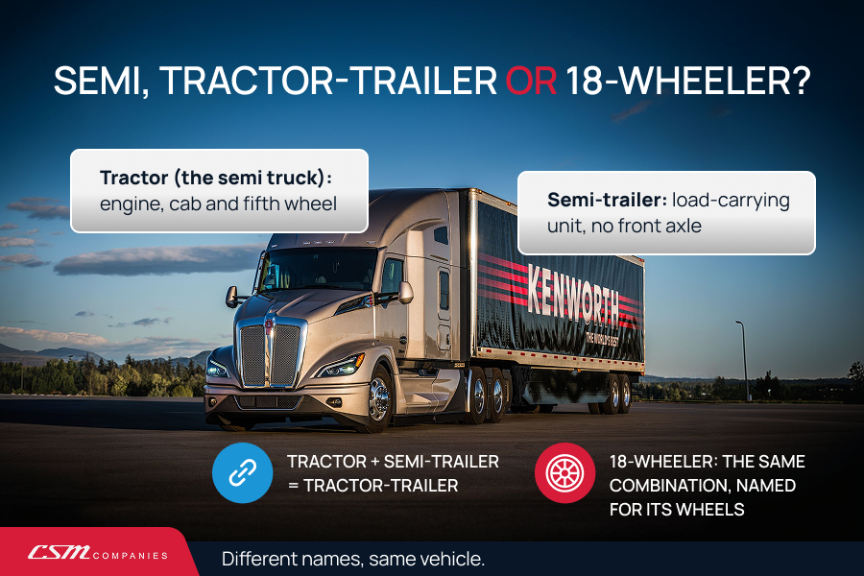
These three terms cause the most confusion, and the short answer is that they usually describe the same thing.
A semi truck, strictly speaking, is the tractor: the powered unit with the engine, cab and fifth wheel. A semi-trailer is the load-carrying unit that rests on that fifth wheel and has no front axle of its own. Put the two together and you have a tractor-trailer.
An 18-wheeler describes the same combination by its wheel count, since a typical tractor-trailer carries 18 wheels across its axles. Big rig and semi are the everyday shorthand. In practice, people use all these names for the tractor-and-trailer you see on the highway.
The distinction matters most when you buy or service one, because a tractor and a trailer are specified, titled and maintained separately, and the tractor is where your powertrain and uptime decisions live.
Common Types of Semi Trucks
Semis are grouped mainly by their cab style and by the trailer they pull.
Day Cabs and Sleeper Cabs
A day cab has no sleeping compartment and is built for regional and local routes where the driver returns home. A sleeper cab adds a berth behind the seats for long-haul work and overnight runs. The choice shapes weight, cost and driver comfort, so it tends to follow the route rather than preference.
Common Trailer Configurations
The trailer defines what the truck can haul:
• Dry van: enclosed general freight.
• Refrigerated (reefer): temperature-controlled food and pharmaceuticals.
• Flatbed: building materials, machinery, and oversized loads.
• Tanker: liquids and gases.
• Lowboy and step-deck: heavy equipment and tall loads.
Matching the trailer to the freight is the first step in specifying the tractor that pulls it, from horsepower to axle configuration.
Browse new and used trucks in our inventory.
What Are Semi Trucks Used For
The semi exists to move freight efficiently over distance, and its versatility comes from swapping trailers. Typical uses include:
• Long-haul freight across states, where sleeper tractors cover high mileage.
• Regional and local delivery, where day cabs run predictable routes.
• Refrigerated distribution for food, beverages, and pharmaceuticals.
• Flatbed hauling for construction, steel, and machinery.
• Specialized transport such as tankers, car haulers, and heavy equipment.
Because one tractor can pull many trailer types, fleets size the truck to the heaviest, most frequent job it will do. Getting that match right protects cost per mile and keeps the truck earning instead of parked, which is where the spec decisions pay off over the life of the truck.
Semi Trucks vs. Straight Trucks and Box Trucks
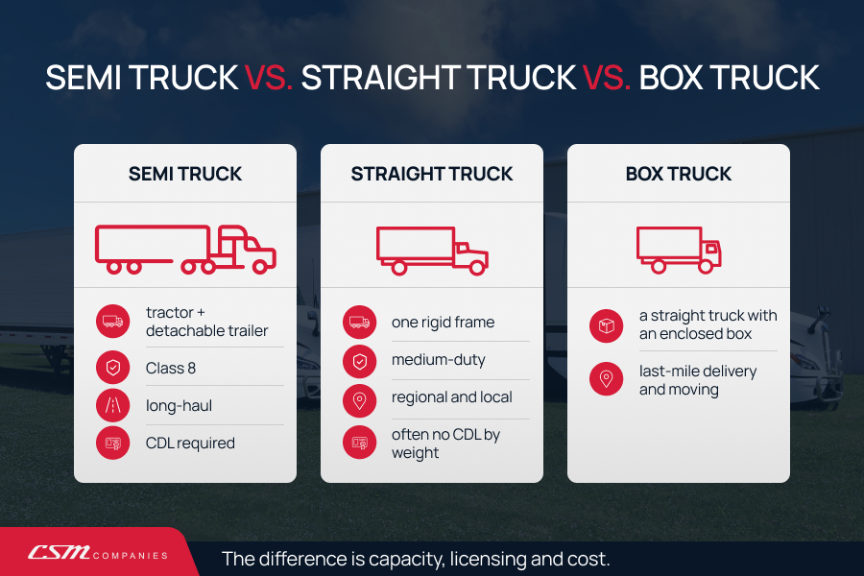
Not every commercial truck is a semi-sized truck. The clearest difference is whether the cargo area is separate from the cab.
A semi truck is an articulated combination: a tractor plus a detachable trailer. A straight truck carries its body and cargo area on the same rigid frame as the cab, with nothing to detach. A box truck is a common straight truck with an enclosed cargo box; the kind used for local delivery and moving.
• Semi truck: tractor plus detachable trailer, Class 8, long-haul and heavy freight, requires a CDL.
• Straight truck: one rigid frame, medium-duty, regional and local work, often no CDL by weight alone.
• Box truck: a straight truck with an enclosed box, built for last-mile delivery and moving.
For an owner, the practical difference is capacity, licensing, and cost. A semi carries and costs more and needs a qualified driver, while a straight or box truck fits lighter, local work.
What to Know Before Operating or Maintaining a Semi Truck
Owning or running a semi is a bigger commitment than a light-duty truck, and a few things are worth understanding up front.
Licensing and Regulations
Operating a semi requires a commercial driver’s license, and interstate operation brings hours-of-service, weight and inspection rules. We raise licensing early when owners are spec’ing a truck, because who can legally drive it affects hiring and cost, not compliance alone.
Maintenance and Uptime
A semi creates value when it is moving, not when it sits, so maintenance belongs in the business plan rather than as an afterthought. Preventative service, OEM-trained technicians and ready access to parts are what keeps a truck on the road.
Prompt parts availability in particular is a direct lever on downtime and revenue, not a convenience. At CSM Companies we support the full lifecycle, from helping you find the right new or used truck to servicing the powertrain and keeping genuine parts in stock across our network.
“The owners who do best treat the truck as a revenue asset,” says CSM Companies service manager. “They spec it for the work, keep up the preventative maintenance, and they are not the ones stuck waiting on a part.”
Keep your truck moving with CSM Companies service and parts.
FAQs About Semi Trucks
The questions owner-operators and new buyers ask most about semi trucks:
A semi truck is the tractor unit that connects to a detachable semi-trailer to haul freight; together they form a tractor-trailer.
The name comes from the semi-trailer, which has no front axle and rests on the tractor’s fifth wheel.
Usually, yes. An 18-wheeler is a tractor-trailer named for its typical 18 wheels.
Most are Class 8, rated above 33,000 pounds, and can run up to 80,000 pounds gross on the interstate.
Yes. A commercial driver’s license is required to operate a semi truck.
A semi has a detachable trailer, while a box truck is a straight truck with the cargo box on the same frame as the cab.
Many have 10 to 18 speeds, though automated manual transmissions are now common.
A tractor alone is roughly 15,000 to 25,000 pounds, while a loaded combination can reach 80,000 pounds on the interstate.
Heavy-duty diesels such as the PACCAR MX-13, Cummins X15 and Detroit DD15, typically 400 to 600 horsepower.
CSM Companies sells new and used trucks and services them across more than 30 locations in six states.
Whether you are buying your first rig or maintaining a fleet, the terms matter less than the decisions behind them: spec for the job, maintain for uptime, and keep parts within reach.
CSM Companies helps with all three, with new and used inventory, service, and parts across more than 30 locations in six states. Tell us about your operation, and we will help you find or service the right truck.
Explore new and used semi trucks in our inventory.